
The Prophet Daniel in a Landscape
late 16th–early 17th century
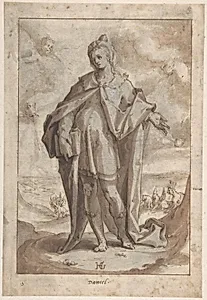
Medium
Pen and brown ink, brush and brown wash, heightened with white over black chalk; incised. There is a doodle in pen and brown ink
Dimensions
10 7/16 x 7 1/8 in. (26.5 x 18.1 cm)
Classification
Drawings
Department
Drawings and Prints
Museum
Metropolitan Museum of Art, New York, NY
Credit
Purchase, Anonymous Gift, in memory of Frits Markus, 1997
Accession Number
1997.155
Rights
Public Domain
Tags
Art Historical Context
In the late 16th to early 17th century, Dutch artist Hendrick Goltzius created *The Prophet Daniel in a Landscape*, a masterful drawing that captures the biblical visionary amid a dramatic natural setting. Goltzius, a leading figure in the Haarlem school and a pioneer of Northern Mannerism, was renowned for his dynamic compositions and virtuosic technique, blending Italian influences with Northern precision. This work reflects the era's fascination with Old Testament prophets, portraying Daniel—famed for his wisdom and divine visions—as a contemplative figure, evoking spiritual depth and human introspection. Executed on a modest sheet measuring 10 7/16 x 7 1/8 inches, the drawing employs pen and brown ink for crisp lines, brush and brown wash for rich tonal modeling, heightened with white over black chalk for luminous highlights, and incised outlines suggesting preparation for printmaking—a hallmark of Goltzius's innovative practice. A whimsical doodle in pen and brown ink adds a personal, spontaneous touch, humanizing the artist's process. Housed in the Metropolitan Museum of Art's Drawings and Prints department (acquired in 1997), this piece exemplifies the technical brilliance of Renaissance draftsmanship, bridging painting and print traditions while inviting viewers to ponder Daniel's prophetic legacy.
About the Artist
Hendrick Goltzius · 1558–1617
Hendrick Goltzius (1558–1617) was the most celebrated engraver of the Northern Renaissance and a pivotal figure in Dutch Mannerism. Born near the German-Dutch border, Goltzius transformed printmaking into a virtuoso art form through his revolutionary 'swelling line' technique, where the burin was manipulated to create lines of varying thickness that produced unprecedented tonal effects and three-d...