
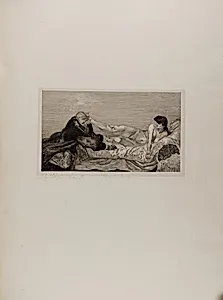
The Proposition, plate six from A Life
1884
Medium
Etching on ivory China paper, laid down on cream laid paper
Dimensions
Image: 19.6 × 34.4 cm (7 3/4 × 13 9/16 in.); Plate, approx: 23.2 × 37 cm (9 3/16 × 14 5/8 in.); Primary support: 21.3 × 36.1 cm (8 7/16 × 14 1/4 in.); Secondary support, approx: 78.8 × 57.5 cm (31 1/16 × 22 11/16 in.)
Classification
etching
Department
Prints and Drawings
Museum
Art Institute of Chicago
Accession Number
155430
Rights
Public Domain
Art Historical Context
**The Proposition, plate six from *A Life*** *Max Klinger, 1884* Max Klinger's *The Proposition* is the sixth plate in his seminal etching cycle *A Life* (*Ein Leben*), a series of ten prints created in 1884 that the psychological and fantastical journey of a woman's existence. As a leading figure in German Symbolism, Klinger blended Realism's precision with dreamlike narratives, exploring themes of desire, fate, and the subconscious—ideas that foreshadowedian psychology. This work exemplifies his innovative approach to printmaking, where intricate vignettes unfold like a graphic novel, captivating late 19th-century audiences amid Europe's fin-de-siècle fascination with the erotic and irrational. Etched on delicate ivory China paper and laid down on cream laid paper, the print showcases Klinger's mastery of the etching technique. This intaglio process, involving acid-biting into a metal plate, allowed for exquisite line work and tonal subtleties, with the thin China paper capturing fine details (image: 19.6 × 34.4 cm). Such luxury supports enhanced the edition's intimacy, making it prized by collectors. Housed in the Art Institute of Chicago's Prints and Drawings department, it highlights etching's role in democratizing complex art beyond painting. Klinger's cycle, including this provocative "proposition" scene, challenged Victorian norms, influencing later Surrealists. A must-see for its technical brilliance and emotional depth! (198 words)
About the Artist
Max Klinger · 1857–1920
Max Klinger, born on February 18, 1857, in Leipzig to a wealthy family, emerged as one of Germany's most innovative artists across painting, sculpture, printmaking, and graphics. Demonstrating early talent, he enrolled at the Academy of Fine Arts in Karlsruhe in 1874 as a pupil of Karl Gussow, following his teacher to the Berlin Academy upon Gussow's appointment as director, and graduated in 1877 ...