
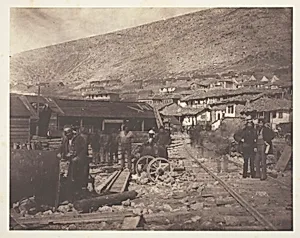
The Railway Yard, Balaklava
1855
Medium
Salted paper print, from the album "Photographic Pictures of the Seat of War in the Crimea" (1856)
Dimensions
Image/paper: 20.6 × 26 cm (8 1/8 × 10 1/4 in.); Mount: 40.4 × 53.4 cm (15 15/16 × 21 1/16 in.)
Classification
salted paper print
Department
Photography and Media
Museum
Art Institute of Chicago
Accession Number
123400
Rights
Public Domain
Art Historical Context
Step into the gritty heart of the Crimean War Roger Fenton's *The Railway Yard, Ballava* (1855), a salted paper print that captures the logistical backbone of British military operations. Balaklava, a vital harbor on the Black Sea, served as the supply hub for Allied forces during the 1853–1856 against Russia. Fenton's image reveals the chaotic yet essential railway yard, where trains unloaded ammunition, food, and troops amid the mud and makeshift infrastructure—offering a rare, unromanticized glimpse into the war's behind-the-scenes machinery. As one of the first war photographers, Fenton pioneered on-site documentation, traveling to Crimea under commission to counter sensationalized newspaper reports. This print, from his groundbreaking 1856 album *Photographic Pictures of the Seat of War in the Crimea*, exemplifies early salted paper techniques: a light-sensitive paper coated with salt and silver nitrate, yielding warm-toned, detailed positives from glass negatives. Measuring 20.6 × 26 cm on its mount, it highlights photography's emerging power to shape public perception, humanizing the distant conflict and influencing journalism forever. Housed in the Art Institute of Chicago's Photography and Media Department, this work underscores Fenton's artistic eye for composition amid hardship, blending documentary realism with subtle drama in light and shadow. A testament to innovation, it invites us to ponder how images first bridged the gap between battlefield and home front.
About the Artist
Roger Fenton · 1819–1819
Roger Fenton (1819–1869), born into a prosperous Lancashire merchant family as the son of banker and MP John Fenton, initially pursued a scholarly path, earning a first-class BA from the University of London in 1840 before studying law at University College London. He abandoned these pursuits for art, training as a painter under the history painter Charles Lucy in London by 1847—the two became clo...