
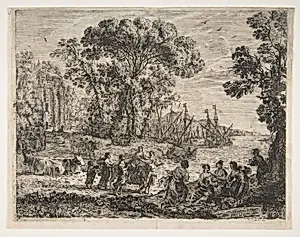
The Rape of Europa
Medium
Etching and drypoint; third state of seven (Mannocci)
Dimensions
sheet: 8 1/16 x 10 3/16 in. (20.5 x 25.8 cm)
Classification
Prints
Department
Drawings and Prints
Museum
Metropolitan Museum of Art, New York, NY
Credit
Harris Brisbane Dick Fund, 1926
Accession Number
26.72.93
Rights
Public Domain
Tags
Art Historical Context
Claude Lorrain, the renowned 17th-century French artist (Claude Gellée, 0–1682),fully captures the classical myth of *The Rape of Europa* in 1634 etching andpoint. Drawing from Ovid's *Metamorphoses*, the scene depicts the beautiful Europa being abducted by Zeus, disguised as a white bull, amid a serene yet dramatic landscape of cows, trees, and distant. Lorrain, celebrated for his luminous, idealized views inspired by the Roman countryside, infuses the composition with a poetic harmony of light and space, blending mythology with his signature Baroque landscape style. Printed as the third state of seven (per Mannocci's catalogue raisonné), this work showcases Lorrain's innovative printmaking techniques. Etching creates precise lines etched into a copper plate with acid, while drypoint adds velvety textures from a burr raised by scratching directly on the plate. These methods allowed Lorrain to achieve atmospheric depth and subtle tonal gradations, making his prints highly prized collector's items even in his lifetime. At 8 1/16 x 10 3/16 inches, the intimate scale invites close contemplation of its intricate details. Acquired through the Harris Brisbane Dick Fund in 1926, this piece from the Metropolitan Museum of Art's Drawings and Prints department exemplifies Lorrain's influence on later landscapists like Turner. It reminds us how prints democratized access to grand mythological narratives, bridging ancient lore with 17th-century artistry.
About the Artist
Claude Lorrain (Claude Gellée) · 1604–1682
Claude Gellée was born around 1600 in the village of Chamagne in the Duchy of Lorraine, from which he would take the professional name by which history knows him: Claude Lorrain. Orphaned young, he traveled south to Rome as a teenager, eventually finding his way into the Naples workshop of Goffredo Wals before apprenticing with the Roman landscapist and fresco painter Agostino Tassi around 1622. F...