
The Rat Catcher
second half 18th century
Medium
Etching
Dimensions
Sheet: 5 9/16 × 4 15/16 in. (14.2 × 12.5 cm) Plate: 5 7/16 × 4 13/16 in. (13.8 × 12.2 cm)
Classification
Prints
Department
Drawings and Prints
Museum
Metropolitan Museum of Art, New York, NY
Credit
Harris Brisbane Dick Fund, 1947
Accession Number
47.100.89
Rights
Public Domain
Tags
Art Historical Context
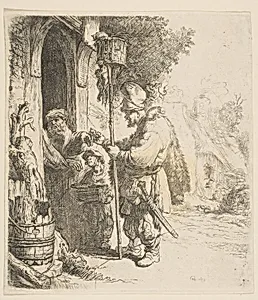
This intriguing etching, titled *The Rat Catcher*, dates to the second half of the eighteenth century and is attributed to James Bretherton, working in the style of or after Rembrandt van Rijn. Housed in the Metropolitan Museum of Art’s Department of Drawings and Prints, the small-scale print measures roughly 5½ by 5 inches and captures a lively street scene featuring a rat catcher surrounded by curious children and onlookers. Such genre subjects, drawn from everyday urban life, were popular in European print culture, reflecting both the practical realities of city living and a growing interest in ordinary people as worthy artistic subjects. Bretherton, an English printmaker active in the 1700s, frequently produced etchings inspired by earlier masters like Rembrandt. The medium of etching allowed for fine, expressive lines that could convey texture—such as the fur of rats or the folds of clothing—while making images widely available to collectors and the public. Acquired by the museum through the Harris Brisbane Dick Fund in 1947, this work exemplifies how eighteenth-century artists adapted seventeenth-century Dutch traditions to new audiences. The scene’s inclusion of rats, children, and men hints at the social dynamics of pest control and community interaction in pre-industrial cities, offering viewers a glimpse into historical daily life through the intimate scale of a print.