
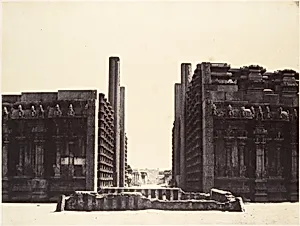
The Raya Gopuram from W
January–March 1858
Medium
Albumen silver print from waxed paper negative
Dimensions
Image: 27.3 x 36.3 cm (10 3/4 x 14 5/16 in.) Mount: 45 x 57.8 cm (17 11/16 x 22 3/4 in.)
Classification
Photographs
Department
Photographs
Museum
Metropolitan Museum of Art, New York, NY
Credit
Gilman Collection, Purchase, Cynthia Hazen Polsky Gift, 2005
Accession Number
2005.100.381.1.10
Rights
Public Domain
Tags
Art Historical Context
Linnaeus Tripe's *The Raya Gopuram from W*, captured between January and March 1858, offers a stunning early photographic glimpse into South Indian temple architecture. Thisen silver print from a paper negative depicts the towering Raya Gopuram grand gateway typical of Dravidian-style Hindu temples—showcasing intricate carvings and soaring verticality that symbolize spiritual ascent. Tripe, a pioneering British photographer and captain in the East India Company's army, meticulously documented such monumental structures during his expeditions, preserving their splendor for global audiences. Created amid Britain's colonial presence in India, the image reflects Tripe's role as official photographer for the Madras Presidency. In 1858, he traveled to sites like Madurai, producing over 200 views to catalog architectural heritage amid rapid change. The waxed paper negative process, a portable evolution of the calotype, allowed crisp details in humid conditions, making this 27.3 x 36.3 cm print a technical marvel of 19th-century photography. Housed in The Metropolitan Museum of Art's Gilman Collection, this work highlights photography's power to bridge cultures, inviting us to marvel at the enduring artistry of ancient temples while appreciating Tripe's precise, almost reverent gaze.
About the Artist
Linnaeus Tripe · 1822–1902
Linnaeus Tripe (1822–1902), born in Devonport, England, as the ninth of twelve children to Mary and Cornelius Tripe, pursued a military career influenced by his sister Emily's marriage to an army colonel. Joining the East India Company's Madras Infantry as a cadet in 1838, he rose to lieutenant in southern India by 1840 and captain in Bangalore by 1854. Extended leave in England from 1850 due to i...