
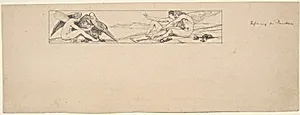
The Release of Prometheus
late 19th–early 20th century
Medium
Pen and black ink on buff stock
Dimensions
3 x 8 3/16 in. (7.6 x 20.8 cm)
Classification
Drawings
Department
Drawings and Prints
Museum
Metropolitan Museum of Art, New York, NY
Credit
Gift of Robert L. Isaacson, 1979
Accession Number
1979.674.8
Rights
Public Domain
Tags
Art Historical Context
Max Klinger’s *The Release of Prometheus* captures a pivotal moment from Greek mythology in a compact yet expressive drawing. Created in the late nineteenth or early twentieth century, the work shows the Titan Prometheus at the instant of his liberation, with an eagle—his former tormentor—prominently featured. Klinger, a leading figure in the German Symbolist movement, often explored themes of suffering, redemption, and the supernatural, using mythological subjects to comment on modern human struggles. Executed in pen and black ink on buff stock, the drawing measures just three inches high, inviting close inspection of its fine linework and dramatic contrasts. This intimate scale underscores the intensity of the scene while highlighting Klinger’s mastery of graphic media; he was equally celebrated for prints and illustrated cycles that influenced later artists such as Edvard Munch. The Met’s acquisition as a gift in 1979 preserves this delicate study for public view. As part of the museum’s Drawings and Prints collection, the work reflects the Symbolist interest in emotional and psychological depth over mere narrative. Its presence alongside larger paintings and sculptures encourages visitors to appreciate how small-scale drawings can convey epic stories with remarkable power.
About the Artist
Max Klinger · 1857–1920
Max Klinger, born on February 18, 1857, in Leipzig to a wealthy family, emerged as one of Germany's most innovative artists across painting, sculpture, printmaking, and graphics. Demonstrating early talent, he enrolled at the Academy of Fine Arts in Karlsruhe in 1874 as a pupil of Karl Gussow, following his teacher to the Berlin Academy upon Gussow's appointment as director, and graduated in 1877 ...