
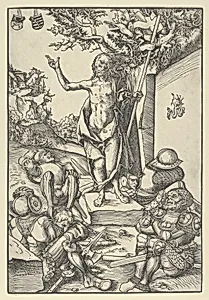
The Resurrection, from The Passion
Medium
Woodcut
Dimensions
Sheet: 9 11/16 × 6 5/16 in. (24.6 × 16 cm)
Classification
Prints
Department
Drawings and Prints
Museum
Metropolitan Museum of Art, New York, NY
Credit
Harris Brisbane Dick Fund, 1926
Accession Number
26.3.3
Rights
Public Domain
Tags
Art Historical Context
Lucas Cranach the Elder (2–1553), a leading figure of the German Renaissance, created *The Resurrection, from The Passion*, a striking woodcut print that captures one of Christianity's pivotal moments: Christ's triumph over death. As part of a series illustrating the Passion—the events leading to and including Jesus's crucifixion and resurrection—this work reflects the era's intense religious fervor. Cranach, a close associate of Martin Luther and a key Protestant artist, used such prints to disseminate Reformation ideals, making sacred narratives accessible to the faithful beyond elite church settings. Rendered in the woodcut medium, a relief printing technique where images are carved into wood blocks and inked for transfer to paper, this 9 11/16 × 6 5/16 in. sheet exemplifies early modern printmaking's power. The stark contrasts of black and white heighten the drama of the Resurrection scene, likely featuring Christ rising gloriously amid astonished soldiers, as suggested by the tags. Woodcuts like this were revolutionary for their reproducibility, allowing widespread distribution of devotional art during a time of religious upheaval. Housed in the Metropolitan Museum of Art's Drawings and Prints department (Harris Brisbane Dick Fund, 1926), this intimate print invites visitors to ponder its cultural weight: a snapshot of faith visualized for the masses, blending artistic innovation with profound spiritual resonance.
About the Artist
Lucas Cranach the Elder · 1472–1553
Lucas Cranach the Elder (c. 1472-1553) was one of the most prominent German Renaissance painters and a key artistic figure of the Protestant Reformation. Born in Kronach, Franconia, to the painter Hans Maler, Cranach began his career in Vienna around 1502, where he became one of the founders of the Danube School, a movement characterized by expressive landscape painting and emotional force. His ea...