
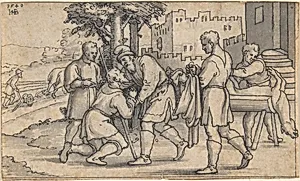
The Return of the Prodigal Son
1540
Medium
Pen and black ink, gray wash
Dimensions
2 5/16 x 3 7/8 in. (5.9 x 9.8 cm)
Classification
Drawings
Department
Drawings and Prints
Museum
Metropolitan Museum of Art, New York, NY
Credit
Rogers Fund, 1919
Accession Number
19.151.3
Rights
Public Domain
Tags
Art Historical Context
Sebald Beham's *The Return of the Proal Son* (1540) captures a pivotal moment from the biblical parable in Luke 15, where the wayward son humbly returns home to his forgiving father. Rendered in pen and black ink with gray wash on a diminutive 2 5/ x 3 78 inches sheet, this exemplifies the meticulous precision of Nuremberg Little Masters—a group of German Renaissance artists renowned for their intricate small-scale works. Beham, active during the Protestant Reformation, infuses the scene with everyday rural details: sturdy buildings, clusters of trees, men at labor, and hints of agriculture, evoking the agrarian life of 16th-century Germany. The medium's subtlety shines in Beham's fine lines and tonal washes, which build depth and narrative drama in a compact format ideal for collectors' albums or study. Likely a standalone sketch rather than a print preparatory, it showcases his mastery of figure grouping and landscape integration, blending religious devotion with genre realism—a hallmark of Northern Renaissance draftsmanship. Housed in the Metropolitan Museum of Art's Drawings and Prints department (Rogers Fund, 1919), this gem invites viewers to ponder themes of redemption amid Reformation-era tensions, when artists like Beham navigated faith, exile, and humanism in their art. A testament to humility in grandeur.
About the Artist
Sebald Beham · 1500–1550
Sebald Beham (1500–1550), a pioneering German printmaker and painter born in Nuremberg, emerged as one of the most prolific artists of the Northern Renaissance. The elder brother of fellow artist Barthel Beham, he grew up in a milieu steeped in artistic tradition, though details of his early training remain sparsely documented. Recorded as a journeyman painter (Malergeselle) by 1521 and a master w...