
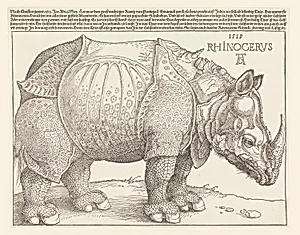
The Rhinoceros
Classification
animals
Department
Smithsonian Collection
Museum
Smithsonian American Art Museum
Credit
Gift of Leo Wallerstein
Accession Number
1950-5-24
Rights
Public Domain
About this artwork
Research in Progress
Art Historical Context
Albrecht Dürer (1471–1528), a master of the Northern Renaissance from Germany, crafted *The Rhinoceros* in1515, showcasing his unparalleled skill in printmaking and scientific observation. As a leading figure in the German Renaissance, Dürer art and natural history, producing detailed studies of animals that blended artistic precision with emerging empirical curiosity. Though the medium is currently under research, Dürer's works from this era were typically woodcuts or engravings, allowing wide dissemination across Europe. This striking depiction captures a rhinoceros—an exotic creature rarely seen in Europe—based on secondhand accounts of one shipped from India to Portugal. Dürer's imaginative rendering portrays the beast as a formidable, armor-plated giant, complete with intricate scales and a horned snout. Far from a mere curiosity, it reflects the era's fascination with the New World and wonders of nature, influencing European views of the animal for over 300 years. Now part of the Smithsonian American Art Museum's collection through the gift of Leo Wallerstein, *The Rhinoceros* endures as a testament to Dürer's genius for transforming limited information into an iconic image. Visitors are drawn to its whimsical yet authoritative style, reminding us how art shapes our understanding of the world.