
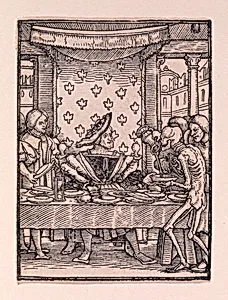
The Rich Man, from The Dance of Death
ca. 1526, published 1538
Medium
Woodcut
Dimensions
sheet: 2 9/16 x 1 15/16 in. (6.5 x 4.9 cm)
Classification
Prints
Department
Drawings and Prints
Museum
Metropolitan Museum of Art, New York, NY
Credit
Rogers Fund, 1919
Accession Number
19.57.27
Rights
Public Domain
Tags
Art Historical Context
In Hans Holbein the Younger's iconic series *The Dance of Death created around 1526 and published in 1538, "The Rich Man" captures the Northern Renaissance master's unflinching meditation on mortality. Designed by Holbein and masterfully cut into wood by Hans Lütburger, this tiny woodcut (just 2 9/16 x 1 15/16 inches) depicts a lavishly dressed wealthy man interrupted at his feast by a skeletal Death figure. Symbols like the hourglass and scattered food underscore time's relentless march and the futility of earthly indulgences, a classic *memento mori* motif. Woodcuts like this were revolutionary for their time, allowing intricate designs to be reproduced affordably and widely across Europe during the Reformation era. Holbein's precise line work, with dramatic contrasts and expressive gestures, brought medieval "Dance of Death" allegories into the Renaissance, equalizing all social classes before the great leveler: Death dances with kings, peasants, and now the rich man alike. This print from the Metropolitan Museum of Art's collection reminds us of 16th-century anxieties over wealth, sin, and salvation, offering timeless wisdom in a deceptively simple image.