
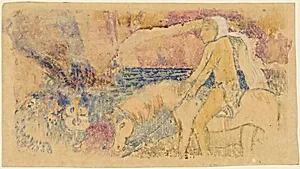
The Rider
c. 1902
Medium
gouache monotype touched with gum or varnish on laid paper
Dimensions
sheet: 32.7 x 59.7 cm (12 7/8 x 23 1/2 in.)
Classification
Department
CG-E
Museum
National Gallery of Art, Washington, D.C.
Credit
Rosenwald Collection
Accession Number
1947.7.60
Rights
Public Domain
Art Historical Context
Paul Gauguin's *The Rider* (c. 1902) captivates with its experimental flair, crafted as a gouache monotype touched with gum or varnish on laid paper Measuring 32.7 x 59.7 cm, this unique print from the National Gallery of Art'swald Collection showcases the artist's late-career innovation. Monotype, a rare printmaking method, involves painting directly on a smooth plate and transferring the image under pressure to paper—yielding just one impression, often enriched here with gouache for vivid color and varnish for a glossy sheen. A Post-Impressionist pioneer, Gauguin rejected European conventions for bold, flattened forms and symbolic narratives inspired by his life in Tahiti and the Marquesas Islands. Created near the end of his life (he died in 1903), *The Rider* reflects his fascination with exotic, primal motifs, evoking a sense of motion and mystery through its horizontal format and dynamic composition. This work highlights Gauguin's influence on modern art, bridging painting and printmaking while celebrating non-Western aesthetics. Visitors will appreciate its tactile luminosity—a testament to his restless creativity.
About the Artist
Paul Gauguin · 1848–1903
Paul Gauguin (1848-1903) was a French Post-Impressionist painter whose bold experiments with color, form, and subject matter made him one of the most influential figures in the transition from 19th-century art to modernism. His rejection of European civilization for the perceived authenticity of 'primitive' cultures established an archetype of artistic exile that continues to resonate. Gauguin's ...