
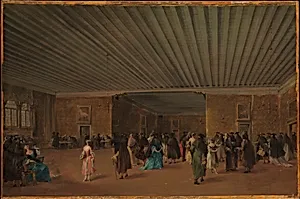
The Ridotto Pubblico at Palazzo Dandolo
ca. 1765–68
Medium
Oil on canvas
Dimensions
13 3/8 x 20 in. (34 x 50.8 cm)
Classification
Paintings
Department
European Paintings
Museum
Metropolitan Museum of Art, New York, NY
Credit
Bequest of Lore Heinemann, in memory of her husband, Dr. Rudolf J. Heinemann, 1996
Accession Number
1997.117.5
Rights
Public Domain
Tags
Art Historical Context
Step into the glittering underbelly of 18th-century Venice with Francesco Guardi's *The Ridotto Pubblico at Palazzo Dandolo* (ca. 1765–68), an enchanting oil on canvas that captures a public gambling den alive with masked revelry. Guardi, a master of the Venetian *veduta* tradition alongside Canaletto, renders the opulent interior of Palazzo Dandolo with his signature loose brushwork and luminous atmosphere. Figures in elaborate costumes—men and women cloaked in anonymity behind bauta masks—huddle around gaming tables, evoking the thrill of chance amid flickering candlelight and rococo splendor. Ridotti like this one were infamous Venetian hotspots in the waning years of the Republic, where nobles and commoners mingled freely under the cover of masks, indulging in games of *faro* and *basset*. Banned in private homes by the Church and state to curb excess, these public venues symbolized Venice's decadent allure, blending social equality with moral peril. Guardi's scene, small yet immersive at 13⅜ × 20 inches, highlights this cultural phenomenon just before the Republic's fall in 1797. Guardi's technique—vibrant highlights and subtle sfumato—infuses the composition with a dreamlike energy, distinguishing his more impressionistic style from rigid topographical views. Now at The Metropolitan Museum of Art, this bequest celebrates Venice's enduring mystique, inviting us to ponder the masks we all wear in pursuit of pleasure.
About the Artist
Francesco Guardi · 1712–1793
Francesco Lazzaro Guardi (1712–1793) was born into a noble family of painters from Trentino who had settled in Venice. His father, Domenico Guardi, a minor painter trained in Vienna, died in 1716, leaving young Francesco to inherit the family workshop alongside his brothers Giovanni Antonio (Gian Antonio) and Niccolò, both artists, and sister Maria Cecilia, who married the renowned Giovanni Battis...