
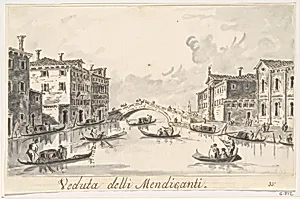
The Rio dei Mendicanti
ca. 1804–25
Medium
Pen and brown ink, gray wash
Dimensions
4 13/16 x 8 1/4 in. (12.3 x 20.9 cm)
Classification
Drawings
Department
Robert Lehman Collection
Museum
Metropolitan Museum of Art, New York, NY
Credit
Robert Lehman Collection, 1975
Accession Number
1975.1.356
Rights
Public Domain
Tags
Art Historical Context
Giacomo Guardi’s *The Rio dei Mendicanti* offers an intimate glimpse of everyday Venetian life in the early nineteenth century. Working in the wake of his celebrated father, Francesco Guardi, Giacomo specialized in delicate views of the city’s canals and architecture. Here, the narrow lined with modest buildings and by a simple bridge animated by small boats,oking the quiet rhythms a neighborhood rather than the monuments usually associated with Venice. Executed in pen and brown ink with gray wash, the drawing demonstrates the fluid, economical technique typical of Venetian view-makers. The rapid strokes and subtle tonal washes capture light and atmosphere with remarkable economy, allowing the artist to suggest both architectural detail and the play of reflections on water. Such works were often created for visiting travelers, serving as portable souvenirs that preserved the city’s distinctive character during a period of political transition after the fall of the Venetian Republic. Now part of the Robert Lehman Collection at The Metropolitan Museum of Art, this modest sheet reflects the enduring appeal of Venetian vedute. It invites viewers to appreciate not only the picturesque setting but also the intimate, almost journalistic approach Guardi brought to recording his native city.
About the Artist
Giacomo Guardi · 1764–1835
Giacomo Guardi (1764–1835) was a Venetian painter who worked in the long shadow of his celebrated father, Francesco Guardi, one of the greatest vedutisti — view painters — of the eighteenth century. Born into one of Venice's most prominent artistic families, Giacomo received his training directly from his father, absorbing both the technical methods and the characteristic style that had made Franc...