
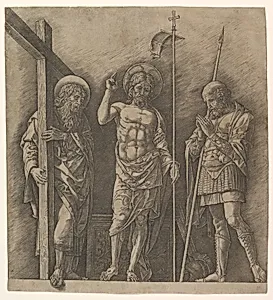
The Risen Christ between Saints Andrew and Longinus
Medium
Engraving
Dimensions
Sheet: 12 5/8 × 11 7/16 in. (32 × 29 cm)
Classification
Prints
Department
Drawings and Prints
Museum
Metropolitan Museum of Art, New York, NY
Credit
Rogers Fund, 1921
Accession Number
21.28
Rights
Public Domain
Tags
Art Historical Context
In the late 15th century, Mantegna, a pioneering Italian Renaissance artist from Padua, collaborated with engraver Gian Marco Cavalli create *The Risen Christ between Andrew and Longinus* 1475. This engraving, measuring 12 5/8 × 11 7/16 inches, captures a pivotal Christian scene: the resurrected Christ flanked by Saint Andrew, the apostle associated with the X-shaped cross, and Saintinus, the Roman centurion who pierced Christ's side the Crucifixion and later converted to faith. Such devotional imagery reflected the era's deep religious fervor and the Renaissance revival of classical forms, blending spiritual narrative with Mantegna's precise, sculptural style. Mantegna's engravings were revolutionary, introducing fine-line techniques from northern Europe to Italy and enabling affordable reproduction of high art for a wider audience. This print exemplifies his mastery of perspective and intricate detail—notice the taut musculature of Christ and the textured crosses—making complex theology accessible. Housed in the Metropolitan Museum of Art's Drawings and Prints department (Rogers Fund, 1921), it highlights printmaking's role in disseminating Renaissance ideals across Europe, bridging elite patronage with popular devotion. A testament to artistic innovation amid Counter-Reformation stirrings, it invites viewers to ponder faith's transformative power.
About the Artist
Andrea Mantegna|Gian Marco Cavalli · 1431–1506
Andrea Mantegna was born around 1431 near Padua, in the Venetian Republic, the son of a carpenter. At approximately age eleven he was taken into the workshop of the Paduan painter and antiquities collector Francesco Squarcione, who enrolled him as a guild member and immersed him in the study of Roman sculpture and classical Latin. Though Mantegna later claimed that Squarcione had exploited his lab...