
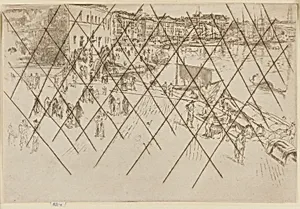
The Riva
1879-1880
Classification
Department
Smithsonian Collection
Museum
Smithsonian American Art Museum
Credit
Gift of Charles Lang Freer
Accession Number
F1893.92
Rights
Public Domain
Tags
About this artwork
4, 1
Art Historical Context
James McNeill Whistler (1834–1903), a pioneering American-born artist renowned for his Aestheticist principles and mastery of tone and harmony, created *The Riva* during his transformative 1879–1880 sojourn in Venice. This etching, part of his celebrated "Second Venice Set," the atmospheric essence of the city's iconic waterfronts—rivas—through delicate lines and subtle gradations. Whistler's etching technique, involving acid-bitten copper plates, allowed him to evoke misty light and fleeting impressions, bridging Realism and Impressionism while prioritizing "art for art's sake" over narrative detail. Printed in a limited edition, *The Riva* exemplifies Whistler's innovative printmaking, where he experimented with drypoint and aquatint for rich textures and tonal depth. These Venetian works revitalized his career after legal battles, like his famous libel suit against critic John Ruskin, and influenced modern printmakers with their emphasis on mood over precision. Generously gifted to the Smithsonian American Art Museum by collector Charles Lang Freer—a devoted Whistler patron whose collection forms the core of the nearby Freer Gallery—this print invites visitors to savor the subtle poetry of Venice, preserved in Whistler's visionary gaze.