
The Sacrifice, from "The Satanic Ones"
ca. 1882
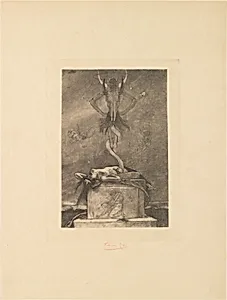
Medium
Soft-ground etching, reproduced in heliogravure
Dimensions
plate: 10 7/8 x 8 in. (27.6 x 20.3 cm) sheet: 17 15/16 x 13 9/16 in. (45.5 x 34.4 cm)
Classification
Prints
Department
Drawings and Prints
Museum
Metropolitan Museum of Art, New York, NY
Credit
Alfred Stieglitz Collection, 1949
Accession Number
49.55.286
Rights
Public Domain
Tags
Art Historical Context
Félicien Rops, a pioneering Belgian artist of the late 19th century, *The Sacrifice* around 1882 as part of his provocative series *The Satanic Ones*. Known his bold Symbolist and Decadent style, Rops blended eroticism, the macabre, and social satire, often exploring themes of vice, religion, and the supernatural. This print features female nudes, emblematic of his unflinching gaze on human desires and taboos during the fin-de-siècle era. Executed in soft-ground etching—a technique that yields fluid, textured lines mimicking drawing—and later reproduced in heliogravure for precise, rich tonal depth, the work showcases Rops' mastery of printmaking. Measuring about 11 x 8 inches on the plate, its intimate scale invites close viewing, heightening the viewer's immersion in its charged imagery. Heliogravure, a photomechanical process popular in the late 1800s, ensured faithful replication, making Rops' daring visions accessible to a wider audience. Housed in the Metropolitan Museum of Art's Drawings and Prints department as part of the Alfred Stieglitz Collection (acquired 1949), *The Sacrifice* reflects the era's fascination with the occult and critiques of bourgeois morality. Rops' prints, once scandalous, now stand as vital documents of artistic rebellion, captivating visitors with their raw intensity and technical finesse.
About the Artist
Félicien Rops · 1833–1898
Félicien Rops, born Félicien Victor Joseph Rops on July 7, 1833, in Namur, Belgium, to a prosperous textile manufacturing family, displayed prodigious artistic talent from youth. The only child of Nicholas Rops and Sophie Maubile, he received private tutoring until age ten, followed by education at a Jesuit school in Namur (1843–1848), the Athénée Royal de Namur, and the Academy of Fine Arts there...