
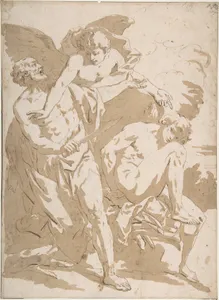
The Sacrifice of Isaac
17th century
Medium
Pen and brown ink, brown wash, corrections in white
Dimensions
12 11/16 x 9 1/4 in. (32.3 x 23.5 cm)
Classification
Drawings
Department
Drawings and Prints
Museum
Metropolitan Museum of Art, New York, NY
Credit
Gift of Cornelius Vanderbilt, 1880
Accession Number
80.3.31
Rights
Public Domain
Tags
Art Historical Context
In the heart of 17th-century Baroque art Johan Carl Loth's * Sacrifice of Isaac* captures pivotal biblical moment from Genesis 22. This gripping drawing depicts Abraham poised to sacrifice his son Isaac with a dagger, only for an angel to intervene, staying his hand. Rendered in pen and brown ink with brown wash and subtle white corrections for highlights, the 12 11/16 x 9 1/4-inch sheet (32.3 x 23.5 cm) showcases's mastery of dynamic linework and tonal modeling, techniques that evoke tension and divine drama. Loth, a German artist active in Venice and Bologna, drew from Venetian masters like Tintoretto, infusing his work with emotional intensity and theatrical lighting—hallmarks of the Baroque era. The male nude figure of Isaac, vulnerable and exposed, contrasts sharply with the winged angel's urgent motion, heightened by the glint of the dagger. Such preparatory drawings were vital for painters like Loth, allowing experimentation before oil canvases. A treasured gift to the Metropolitan Museum of Art from Cornelius Vanderbilt in 1880, this piece from the Drawings and Prints department invites visitors to ponder faith, obedience, and mercy. Its intimate scale belies its monumental storytelling power.