
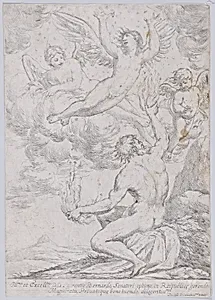
The Fall of Icarus
1650–1700
Medium
Etching
Dimensions
Sheet (Trimmed): 11 13/16 × 8 5/16 in. (30 × 21.1 cm)
Classification
Prints
Department
Drawings and Prints
Museum
Metropolitan Museum of Art, New York, NY
Credit
Purchase, The Elisha Whittelsey Collection, The Elisha Whittelsey Fund, 1971
Accession Number
1971.558.6
Rights
Public Domain
Art Historical Context
Giuseppe Diamantini's *The Fall of Icarus an etching from around 1650–1700, captures the dramatic moment from Greek mythology when Icarus plummets into the sea after flying too close to the sun his wax wings melting. As a Venetian artist active during the Baroque era, Diamantini infused his works with the period's characteristic energy and theatricality, drawing on classical tales to explore themes of hubris and human ambition. Etching, Diamantini's chosen medium, exemplifies 17th-century printmaking innovation. By coating a copper plate with acid-resistant ground, scratching lines through it, and immersing in acid, artists like Diamantini achieved intricate, expressive details—perfect for conveying motion and emotion in compact formats. This sheet, trimmed to 11 13/16 × 8 5/16 inches, reflects the portability and reproducibility of prints, making high art accessible beyond elite patrons. Housed in the Metropolitan Museum of Art's Drawings and Prints department, acquired through The Elisha Whittelsey Fund in 1971, this piece highlights Baroque print culture's role in disseminating mythological narratives across Europe. It invites visitors to ponder timeless warnings against overreaching, rendered with Diamantini's masterful linework.
About the Artist
Giuseppe Diamantini · 1621–1705
Comment on works: Religious; Mythology; History