
Medium
Hand-colored etching and aquatint
Dimensions
Sheet: 5 1/2 × 8 5/16 in. (14 × 21.1 cm)
Classification
Prints
Department
Drawings and Prints
Museum
Metropolitan Museum of Art, New York, NY
Credit
The Elisha Whittelsey Collection, The Elisha Whittelsey Fund, 1959
Accession Number
59.533.1620(13)
Rights
Public Domain
Tags
Art Historical Context
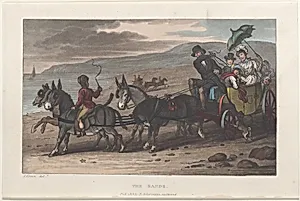
**The Sands (1813)**, a vibrant hand-colored etching and aquat by Thomas Rowlandson, with publication by Rudolph Ackermann in London and contributions from James Green, captures the lively bustle of Regency-era seaside leisure. Measuring just 5½ × 8⅜ inches, this intimate print from the Metropolitan Museum Art's Elisha Whittelsey Collection depicts men, women, horses, carriages thronging a sandy beach—likely a fashionable resort like Brighton or Margate Rowlandson, a master caricaturist known for his satirical wit, infuses the scene with humorous, exaggerated figures enjoying promenade strolls, horse rides, and social chatter amid the waves. Created during the Napoleonic Wars' height, when Britons sought escapist pleasures at coastal spots popularized by the Prince Regent, *The Sands* reflects the era's growing tourism boom. Aquatint, a technique pioneered for its soft, painterly tones mimicking watercolor, combined with etching for crisp lines and meticulous hand-coloring, made such prints affordable collector's items. Ackermann's Repository of Arts championed these vivid topographical views, blending artistry with social commentary. This charming work not only showcases Rowlandson's dynamic compositions but also preserves a snapshot of 19th-century British merriment, inviting us to imagine the salt spray and laughter on those sunlit sands. (198 words)
About the Artist
Rudolph Ackermann, London|Thomas Rowlandson|James Green · 1794–1832
**Rudolph Ackermann (1764–1834)** was a pivotal Anglo-German publisher, printseller, and entrepreneur whose London-based business shaped Regency-era visual culture through innovative printmaking and illustrated publications. Born in Stollberg, Saxony, he trained as a saddler and coach-builder before moving to London around 1787. He initially worked in carriage design and related trades, later esta...