
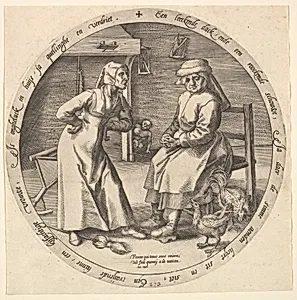
The Scolding Woman and the Cackling Hen
Medium
Engraving
Dimensions
Plate diameter: 7 1/16 in. (18 cm) Sheet: 7 5/16 × 7 3/16 in. (18.5 × 18.2 cm)
Classification
Prints
Department
Drawings and Prints
Museum
Metropolitan Museum of Art, New York, NY
Credit
Harris Brisbane Dick Fund, 1946
Accession Number
46.21(23)
Rights
Public Domain
Tags
Art Historical Context
Created around 1568, *The Scolding Woman and the Cackling Hen* is a finely detailed engraving after a design by Pieter Bruegel the Elder, by the skilled Antwerp printmaker Jan Wierix. Bruegel, celebrated for vivid scenes of everyday life, often infused his work with moral lessons drawn from Flemish proverbs and popular culture. Here, the circular composition centers on a domestic quarrel, with a woman’s sharp words visually echoed by the noisy hen at her feet—an amusing yet pointed comparison that would have resonated with 16th-century viewers familiar with sayings about gossip and temper. As an engraving, the work exemplifies the reproductive print medium’s growing importance during the Northern Renaissance. These affordable, widely circulated images allowed Bruegel’s witty observations to reach audiences far beyond those who could afford his paintings. The meticulous line work captures both the textures of clothing and the lively expressions of the figures, demonstrating Wierix’s technical mastery while preserving Bruegel’s distinctive style of moral satire. Today housed in the Metropolitan Museum of Art, this small print (just over seven inches across) offers a charming window into Renaissance humor and social commentary, reminding us that timeless human foibles—such as the tendency to scold—have long been fair game for artists.
About the Artist
Pieter Bruegel the Elder|Jan (Johannes) Wierix · 1525–1569
Pieter Bruegel the Elder, a pioneering Netherlandish painter of the Renaissance, was born around 1525–1530, likely in Breda in the Duchy of Brabant (present-day Netherlands). Little is known of his early family background, but he apprenticed under the Antwerp painter and designer Pieter Coecke van Aelst between approximately 1545 and 1550, mastering tapestry design, architecture, and painting tech...