
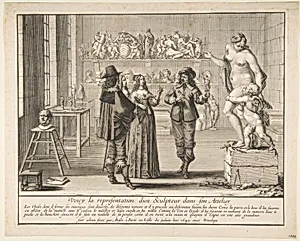
The Sculptor
1642
Medium
Etching
Dimensions
Sheet: 10 15/16 x 13 9/16 in. (27.8 x 34.5 cm) Plate: 10 1/4 × 12 11/16 in. (26 × 32.3 cm)
Classification
Prints
Department
Drawings and Prints
Museum
Metropolitan Museum of Art, New York, NY
Credit
Harris Brisbane Dick Fund, 1924
Accession Number
24.36.7
Rights
Public Domain
Tags
Art Historical Context
In the bustling heart of a 17th-century sculptor's studio comes *The Sculptor* (1642), a masterful etching by French printmaker Abraham Bosse. This intricate print captures the artist at work amid a lively tableau of classical inspiration: muscular male figures, elegant women, female nudes as models or studies, and iconic mythological statues of Venus and Cupid. Bosse, a key figure in the early Académie Royale de Peinture et de Sculpture, used etching's fine, fluid lines to render the textures of marble, plaster casts, and tools with remarkable precision, bringing the creative chaos of the workshop to life on a modest plate measuring about 10 x 13 inches. Created during France's Baroque era under Louis XIII, the work reflects the era's reverence for antiquity and the rising status of artists as intellectual craftsmen. Bosse's detailed scenes often documented professions and daily life, making this piece a vivid window into the sculptor's world—where myth met modernity. Etching, a technique Bosse championed through his influential treatises, allowed for affordable dissemination of such images, democratizing art education. Today, housed in the Metropolitan Museum of Art's Drawings and Prints department, *The Sculptor* invites us to marvel at the fusion of labor and legend, reminding visitors of the timeless passion behind every chisel mark.
About the Artist
Abraham Bosse · 1602–1676
Abraham Bosse (1604–1676) was a French printmaker and theorist whose approximately 1,600 etchings provide an unparalleled visual record of 17th-century French life. Born to Huguenot parents in Tours, he trained in Paris under Melchior Tavernier and became a devoted follower of Jacques Callot's technical innovations. Bosse's meticulous etchings depicted subjects ranging from daily life and fashion ...