
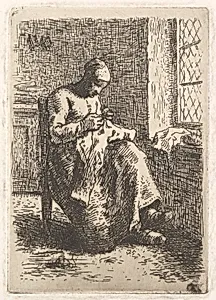
The Seamstress
Medium
Etching on chine collé; second state
Dimensions
plate: 4 1/8 x 2 15/16 in. (10.5 x 7.5 cm) sheet: 19 1/4 x 14 1/4 in. (48.9 x 36.2 cm)
Classification
Prints
Department
Drawings and Prints
Museum
Metropolitan Museum of Art, New York, NY
Credit
Gift of Mrs. and Mrs. Robert Paul Mann, 1981
Accession Number
1981.1232.2
Rights
Public Domain
Tags
Art Historical Context
Jean-François Millet's *The Seamstress* (3) captures the quiet dignity of everyday labor through the image of a woman intently at work, a recurring theme in the artist's oeuvre. A leading figure in the Realism movement the Barbizon school, elevated ordinary rural and working-class lives to subjects of profound artistic nobility, moving away from the idealized scenes of academic art. This etching reflects his empathy for the toil of the humble, particularly women engaged in domestic crafts like sewing. Rendered as a second-state etching on chine collé—a technique where a delicate sheet of thin Chinese paper is adhered to a sturdier support during printing—this print exemplifies Millet's mastery of intaglio processes. The modest plate size (4 1/8 x 2 15/16 in.) invites intimate viewing, allowing fine lines and textures to convey the seamstress's concentration and the subtle play of light. Chine collé enhanced the subtlety of tones, making it ideal for Millet's nuanced depictions of texture and form. Housed in the Metropolitan Museum of Art's Drawings and Prints department (gift of Mr. and Mrs. Robert Paul Mann, 1981), *The Seamstress* underscores the cultural importance of prints in democratizing art during the 19th century, bringing Millet's humanistic vision to wider audiences beyond paintings.
About the Artist
Jean-François Millet · 1814–1875
Jean-François Millet (1814-1875) was a French painter and one of the founders of the Barbizon school, whose dignified depictions of peasant laborers transformed how art could represent rural life. His monumental images of sowers, gleaners, and field workers elevated common people to subjects previously reserved for mythological or historical figures, making him a pivotal figure in the development ...