
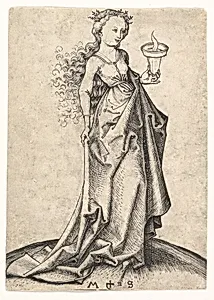
The Second Wise Virgin
1470–1491
Medium
Engraving
Dimensions
Sheet: 4 7/16 × 3 1/8 in. (11.3 × 8 cm)
Classification
Prints
Department
Drawings and Prints
Museum
Metropolitan Museum of Art, New York, NY
Credit
George Khuner Collection, Bequest of Marianne Khuner, 1984
Accession Number
1984.1201.50
Rights
Public Domain
Tags
Art Historical Context
In the late 15th century, Schongauer, a pioneering German engraver and painter from Colmar, crafted *The Second Wise Virgin* as part of a renowned series depicting the Parable of the Ten Virgins from the Gospel of Matthew. This engraving, dated between 1470 and 1491, portrays one of the wise virgins—symbolizing spiritual preparedness and vigilance for Christ's return—holding a lamp and vessel, her serene expression and flowing robes evoking the late Gothic elegance of Northern Renaissance art. Schongauer's works bridged medieval piety with emerging realism, making religious narratives accessible to a wide audience through affordable prints. As one of the first masters of engraving, Schongauer etched fine lines into a copper plate with extraordinary precision, using cross-hatching and stippling to create depth, texture, and subtle shading on this modest 4 7/16 × 3 1/8 in. sheet. His technical innovations influenced later giants like Albrecht Dürer, elevating prints from mere reproductions to independent artworks prized for their detail and devotional power. Today, housed in the Metropolitan Museum of Art's George Khuner Collection, this delicate engraving invites visitors to ponder timeless themes of wisdom and faith, while marveling at the enduring craft of early printmaking. A testament to women's symbolic roles in Christian iconography, it captures the spiritual intensity of its era in intimate scale.
About the Artist
Martin Schongauer · 1435–1491
Martin Schongauer, born around 1450–1453 in Colmar, Alsace, emerged from a family of skilled artisans. The third of four or five sons of goldsmith Caspar Schongauer, who had relocated from Augsburg to Colmar around 1440, Martin was immersed in the goldsmith's trade from youth, likely receiving his initial training in his father's workshop—a common path for early engravers. He further honed his ski...