
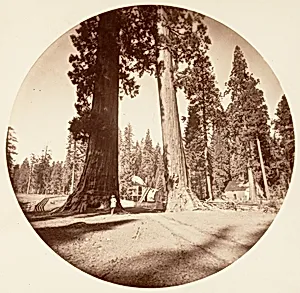
The Sentinels - Calaveras Grove
ca. 1878
Medium
Albumen silver print from glass negative
Dimensions
Image: 12.5 x 12.5 cm (4 15/16 x 4 15/16 in.), circular Album page: 24 x 25.1 cm (9 7/16 x 9 7/8 in.)
Classification
Photographs
Department
Photographs
Museum
Metropolitan Museum of Art, New York, NY
Credit
Gilman Collection, Gift of The Howard Gilman Foundation, 2005
Accession Number
2005.100.556 (2)
Rights
Public Domain
Tags
Art Historical Context
Carleton E. Watkins’s *The Sentinels – Calaveras Grove* captures the majestic presence of towering giant sequoias in California’s Calaveras Big Trees State Park. Created around 1878, the circular albumen silver print showcases Watkins’s signature approach to Western landscape photography. Known for his large-format glass negatives, Watkins helped define how Americans visualized the natural wonders of the West during the post–Civil War era. The albumen process, which prints from a glass negative onto paper coated with egg-white emulsion, allowed Watkins to render extraordinary detail and rich tonal contrasts in the trees’ textured bark and dappled light. The unusual round format draws the viewer’s eye inward, emphasizing the trees as solemn guardians of the forest—an effect reinforced by the work’s title. Watkins’s photographs played a vital role in promoting both tourism and conservation, bringing distant wilderness scenes to Eastern audiences and influencing the establishment of national parks. This intimate print from the Metropolitan Museum’s collection invites modern viewers to appreciate the quiet grandeur of these ancient trees and the pioneering artistry that preserved their image for generations.
About the Artist
Carleton E. Watkins · 1829–1916
Carleton E. Watkins (1829–1916), one of America's pioneering landscape photographers, was born on November 11, 1829, in Oneonta, New York, the eldest of eight children to carpenter John Watkins and innkeeper Julia. Drawn by the Gold Rush, he arrived in San Francisco in 1851 at age 22 alongside childhood friend Collis Huntington, who later became a railroad tycoon. Initially working as a carpenter ...