
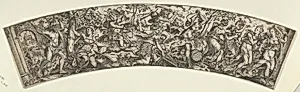
The Seven Liberal Arts Persecuted by Pluto and Bacchus
ca. 1554–91
Medium
Etching
Dimensions
Sheet: 2 1/2 × 11 11/16 in. (6.4 × 29.7 cm)
Classification
Prints|Ornament & Architecture
Department
Drawings and Prints
Museum
Metropolitan Museum of Art, New York, NY
Credit
The Elisha Whittelsey Collection, The Elisha Whittelsey Fund, 1949
Accession Number
49.20.25
Rights
Public Domain
Tags
Art Historical Context
In Jost Amman's etching *The Seven Liberal Arts Peruted by Pluto and Bacchus* (ca. 1554–91), the Swiss artist vividly captures a dramatic allegory from the Renaissance era. Amman, a prolific woodcutter and engraver active in 16th-century Germany, depicts the classical Seven Liberal Arts—grammar, rhetoric, dialectic, arithmetic, geometry,, and astronomy—under siege by the gods Pluto (ruler of the underworld, symbolizing greed or death) and Bacchus ( of wine, embodying revelry). Surrounding them are mischievous satyrs and fierce boars, representing primal vices that threaten intellectual pursuits. This narrow, horizontal sheet (2 1/2 × 11 11/16 in.) exemplifies Amman's mastery of intricate, ornamental prints often used in books on arts and architecture. The artwork reflects Renaissance humanism's reverence for the liberal arts, rooted in medieval trivium and quadrivium curricula, now clashing with pagan forces in a moral cautionary tale. Produced during a time when prints democratized complex iconography, Amman's piece likely adorned scholarly texts or served as decorative ornament, highlighting the era's tension between reason and indulgence. Etching, Amman's favored medium here, allowed for delicate lines and tonal depth through acid-biting copper plates—a innovative technique that made his detailed compositions affordable and widely reproducible. Housed in the Metropolitan Museum of Art's Elisha Whittelsey Collection, this print showcases Amman's enduring influence on European graphic arts.
About the Artist
Jost Amman · 1539–1591
Jost Amman (1539–1591) was a Swiss-born woodcut designer, engraver, and illustrator who became one of the most prolific and influential graphic artists of sixteenth-century Germany, producing an output of extraordinary range and technical virtuosity that shaped the visual culture of the later Reformation era. Born in Zurich, Amman moved to Nuremberg around 1560, the city that had been the center o...