
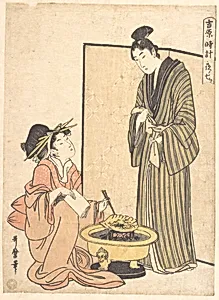
吉原時計 夜の七つ|The Seventh Hour of the Night
ca. 1800
Medium
Woodblock print; ink and color on paper
Dimensions
H. 9 1/4 in. (23.5 cm); W. 6 3/4 in. (17.1 cm)
Classification
Prints
Culture & Period
Japan · Edo period (1615–1868)
Department
Asian Art
Museum
Metropolitan Museum of Art, New York, NY
Credit
Gift of Estate of Samuel Isham, 1914
Accession Number
JP989
Rights
Public Domain
Tags
Art Historical Context
In the vibrant world of Edo-period Japan (1615–1868), Kitagawa Utam's woodblock print *The Seventh Hour of the* (ca. 1800) captures a fleeting moment in Yoshiwara, Tokyo's famed pleasure district. Part of the "Yoshiwara Clock" series, depicts the lively atmosphere at 10 p.m., with elegantly dressed courtesans, male patrons, and hints of food and drink amid intimate revelry. These small-scale prints (just 9¼ × 6¾ inches) were designed for personal enjoyment, reflecting the ukiyo-e ("pictures of the floating world") tradition that celebrated ephemeral pleasures like beauty, nightlife, and urban sophistication. Utamaro, a master of *bijin-ga* (images of beautiful women), excelled in rendering delicate features, flowing kimonos, and subtle expressions using intricate woodblock techniques. Artisans carved blocks for each color layer—ink and pigments applied precisely on paper—yielding the print's luminous hues and fine lines. His innovative shading (*fuki-bokashi*) added depth and mood, making figures seem alive under lantern light. This Metropolitan Museum of Art treasure, gifted in 1914, offers a window into Japan's licensed red-light culture, where Yoshiwara's oiran (high-ranking courtesans) embodied idealized femininity. Utamaro's work not only democratized art for the masses but also preserved the sensory allure of Edo nightlife, blending sensuality with exquisite craftsmanship.
About the Artist
Kitagawa Utamaro · 1753–1806
Kitagawa Utamaro (c. 1753-1806) was one of the most celebrated masters of ukiyo-e woodblock printing, revolutionizing the art of bijin-ga (pictures of beautiful women) during Japan's Edo period. Born Kitagawa Ichitaro, his early life remains shrouded in mystery, with conflicting accounts placing his birth in Kyoto, Osaka, Yoshiwara in Edo (modern Tokyo), or Kawagoe in Musashi Province. Under the t...