
The Shadow
1861
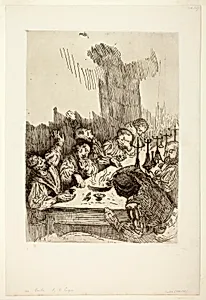
Medium
Etching with foul biting and plate tone in warm black on ivory laid paper
Dimensions
Plate: 37 × 26.8 cm (14 5/8 × 10 9/16 in.); Sheet: 49.6 × 33.2 cm (19 9/16 × 13 1/8 in.)
Classification
etching
Department
Prints and Drawings
Museum
Art Institute of Chicago
Accession Number
104908
Rights
Public Domain
Art Historical Context
Alphonse Legros' *The Shadow* (1861) is a striking etching that captures the French artist's early mastery of printmaking during the Realist movement. in Dijon and trained in Paris, Legros drew inspiration from masters like Courbet, emphasizing truthful observation over idealization. This work, housed in the Art Institute of Chicago's Prints Drawings department, exemplifies his toward innovative graphic techniques at age 22, just as he began collaborating with contemporaries like James McNeill Whistler. The medium—etching with foul biting and plate tone in warm black ink on ivory laid paper—highlights Legros' technical prowess. Foul biting occurs when acid unexpectedly corrodes the plate, creating organic, textured pits that add atmospheric depth and unpredictability to the shadowy forms. Plate tone, a veil of ink left on the surface, enhances subtle gradations, evoking mystery and light play in the composition. Measuring 37 × 26.8 cm on plate, its intimate scale invites close inspection, revealing the tactile richness of 19th-century intaglio processes. As part of the etching revival in mid-19th-century France, *The Shadow* underscores printmaking's resurgence as a fine art, bridging painting and graphics. Legros' later career in London further elevated etching's prestige, influencing British artists and collectors. This piece remains a testament to how shadow—not just light—could convey emotional and perceptual intrigue.
About the Artist
Alphonse Legros · 1837–1911
Alphonse Legros (1837–1911) was born in Dijon, France, and trained in Paris at the drawing school of Horace Lecoq de Boisbaudran, whose unconventional teaching method — which emphasised memory drawing and acute observation over academic convention — would leave a lasting mark on Legros's practice. At Lecoq's school he formed friendships with Jules Dalou and Auguste Rodin that endured throughout hi...