
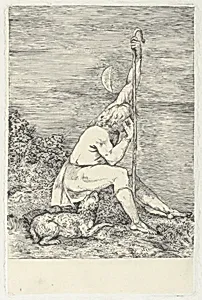
The Shepherd
Medium
Engraving
Dimensions
Plate: 4 1/4 × 3 1/8 in. (10.8 × 7.9 cm) Sheet: 9 11/16 × 7 3/8 in. (24.6 × 18.8 cm)
Classification
Prints
Department
Drawings and Prints
Museum
Metropolitan Museum of Art, New York, NY
Credit
The Elisha Whittelsey Collection, The Elisha Whittelsey Fund, 2013
Accession Number
2013.34
Rights
Public Domain
Tags
Art Historical Context
"The Shepherd" is a delicate engraving from 1828, created by British artists Welby Sherman and Samuel Palmer, possibly inspired by the Renaissance master Albrecht Dürer. Measuring just 4¼ × 3⅛ inches on the plate, this intimate print captures a pastoral scene featuring shepherds and loyal dogs, evoking the timeless harmony between humanity and nature. Housed in the Metropolitan Museum of Art's Drawings and Prints department, it entered the collection through The Elisha Whittelsey Fund in 2013. Engraving, a meticulous intaglio technique where lines are incised into a metal plate and inked to transfer to paper, allowed for exquisite detail in such a compact format. Palmer, a key figure in the Romantic Shoreham Ancients circle, admired early masters like Dürer, whose precise line work influenced this piece's clarity and emotional depth. Produced during the early 19th century, it reflects a nostalgic return to rural idylls amid Britain's Industrial Revolution. This work invites viewers to pause and appreciate its subtle textures—the woolly coats of the dogs, the shepherd's attentive gaze—reminding us of art's power to preserve simple, enduring joys. A gem for print enthusiasts, it showcases how 19th-century artists bridged old techniques with Romantic sensibility.
About the Artist
Welby Sherman|Samuel Palmer|Albrecht Dürer (British|British|German) · 1827 |1805 |1471 –1836 |1881 |1528
British, active 1827–36|British, London 1805–1881 Redhill, Surrey|German, Nuremberg 1471–1528 Nuremberg