
Apollo and Diana
ca. 1503
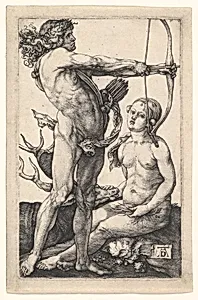
Medium
Engraving
Dimensions
sheet: 4 9/16 x 2 7/8 in. (11.5 x 7.3 cm) plate: 1 15/16 x 1 1/4 in. (4.9 x 3.3 cm)
Classification
Prints
Department
Drawings and Prints
Museum
Metropolitan Museum of Art, New York, NY
Credit
Fletcher Fund, 1919
Accession Number
19.73.76
Rights
Public Domain
Tags
Art Historical Context
Albrecht Dürer, preeminent German artist of the Northern Renaissance, created *Apollo and Diana* around 1503 as a delicate engraving on a remarkably small plate—just under 2 by 1.25 inches. This intimate print depicts the classical deities Apollo, god of the sun and music, and his twin sister Diana, goddess of the hunt and moon, both poised with bows and arrows in a harmonious, nude embrace that evokes ideal human proportions inspired by ancient Greco-Roman sculpture. Dürer's fascination with mythology reflects the Renaissance humanist revival of classical themes, blending Northern precision with Italianate grace following his travels to Venice. Masterfully executed in engraving—a technique Dürer elevated to high art through his virtuoso use of the burin—the image bursts with intricate line work. Fine cross-hatching and subtle tonal gradations convey volume, texture, and light on the figures' lithe forms, proving that monumental beauty could thrive in miniature scale. Printed on a slightly larger sheet, it was designed for collectors, showcasing Dürer's innovative printmaking that democratized fine art beyond paintings. Housed in the Metropolitan Museum of Art's Drawings and Prints department (Fletcher Fund, 1919), this gem highlights Dürer's enduring legacy: bridging Gothic detail with Renaissance ideals, influencing generations of printmakers, and inviting viewers to ponder the divine harmony of the cosmos through archery poised for action.
About the Artist
Albrecht Dürer · 1471–1528
Albrecht Dürer (1471–1528) stands as the preeminent figure of the Northern Renaissance and arguably the most influential artist in the history of printmaking. Born in Nuremberg on May 21, 1471, and dying in the same city on April 6, 1528, Dürer revolutionized the status of the artist in Northern Europe, transforming printmaking from a commercial craft into an independent fine art and establishing ...