
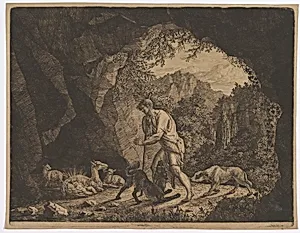
The Shepherd Finding Romulus near the Goat
Medium
Etching on brown paper; state before the inscription
Dimensions
sheet: 10 3/16 x 13 3/16 in. (25.9 x 33.5 cm) plate: 9 7/8 x 12 13/16 in. (25.1 x 32.6 cm)
Classification
Prints
Department
Drawings and Prints
Museum
Metropolitan Museum of Art, New York, NY
Credit
Janet Lee Kadesky Ruttenberg Fund, in honor of Colta Ives, 2010
Accession Number
2010.79
Rights
Public Domain
Tags
Art Historical Context
This etching by Carl Baron vonittinghoff captures a pivotal moment from Rome’s founding myth: a humble shepherd discovering the infant Romulus near a goat. The scene draws on ancient legends in which the twins Romulus and Remus, abandoned the Tiber, are rescued and nurtured in the wild before fulfilling their destiny as founders of a great city. Though the date of the print remains unknown, the work reflects a long tradition of artists interpreting these stories to explore themes of fate, nature, and humble beginnings. Printed on warm brown paper in a state before any inscription, the etching showcases the artist’s command of fine line work and tonal subtlety. Etchings of this kind allowed 18th- and 19th-century printmakers to reach wider audiences with mythological subjects that had once been reserved for paintings or frescoes. The choice of brown paper lends the scene an earthy warmth that complements the pastoral setting. Acquired by the Metropolitan Museum of Art in 2010 through the Janet Lee Kadesky Ruttenberg Fund, this impression preserves an early stage of the plate, offering viewers a glimpse into the printmaking process itself. The simple yet evocative composition invites us to consider how foundational myths continue to resonate through intimate works on paper.