
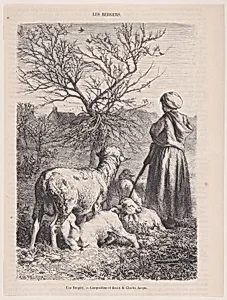
Une Bergère
ca. 1852
Medium
Wood engraving
Dimensions
Sheet (Trimmed): 8 7/8 × 6 11/16 in. (22.5 × 17 cm) Image: 7 13/16 × 5 1/2 in. (19.8 × 14 cm)
Classification
Prints
Department
Drawings and Prints
Museum
Metropolitan Museum of Art, New York, NY
Credit
Harris Brisbane Dick Fund, 1933
Accession Number
32.36.9
Rights
Public Domain
Art Historical Context
**Une Bergère (A Shepherdess)**, created around 1852 by French artists Charles Jacque and Rouget, captures the charm of rural life through the intimate medium of wood engraving. collaborative print, measuring about ⅞ × 6⅝ inches, depicts a shepherdess—evoking timeless pastoral scenes of 19th-century France. Wood engraving, a technique where intricate designs are carved into wood blocks for printing, allowed for detailed, reproducible images that brought art to wider audiences via books and periodicals. In the mid-19th century, as Realism and the Barbizon movement celebrated everyday countryside motifs, works like this highlighted the beauty of peasant life and nature. Jacque, a noted printmaker, and Rouget contributed to a flourishing print culture that democratized visual storytelling. The fine lines and textures achievable in wood engraving made it ideal for nuanced figures and landscapes, bridging fine art with popular illustration. Acquired through the Harris Brisbane Dick Fund in 1933, *Une Bergère* resides in The Metropolitan Museum of Art's Drawings and Prints department. It invites visitors to appreciate how 19th-century innovations in printmaking preserved fleeting moments of rural serenity for generations.
About the Artist
Charles Jacque|François Rouget · 1813–1894
Charles-Émile Jacque (1813–1894) was a pioneering French painter, engraver, and illustrator whose career bridged the worlds of printmaking and pastoral painting. Born in Paris amid a difficult childhood, he apprenticed at age seventeen to a map engraver, mastering drypoint technique and producing his first etching in 1830—a copy of a head after Rembrandt. After serving seven years in the French Ar...