
The Ship of Fortune
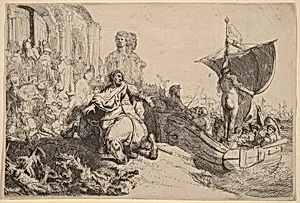
Medium
etching
Dimensions
sheet (trimmed to plate mark): 11.3 x 16.8 cm (4 7/16 x 6 5/8 in.)
Classification
Department
CG-E
Museum
National Gallery of Art, Washington, D.C.
Credit
Rosenwald Collection
Accession Number
1943.3.7092
Rights
Public Domain
Art Historical Context
### The Ship of Fortune Step aboard the whimsical world of Rembrandt van Rijn's *The Ship of Fortune* (1633), a masterful etching from the Dutch master's early career. Created when Rembrandt was just 27 and establishing his reputation in Amsterdam during the Dutch Golden Age, this intimate print—trimmed to a compact 11.3 x 16.8 cm—captures his innovative spirit. Housed in the National Gallery of Art's Rosenwald Collection, it exemplifies the Baroque era's blend of drama, light, and human emotion in print form. Etching, Rembrandt's chosen medium here, involved coating a copper plate with acid-resistant ground, scratching lines into it, and submerging it in acid to "bite" the grooves. What sets Rembrandt apart was his revolutionary wiping techniques, layering ink unevenly to produce rich tonal gradients and velvety textures that rivaled his oil paintings. This small sheet bursts with movement and depth, transforming a simple print into a window on fortune's unpredictable seas. The title hints at classical allegory—the Ship of Fortune symbolizing life's voyages guided by chance—reflecting 17th-century fascination with fate amid prosperity. As a prime example of Rembrandt's etching prowess, it invites us to ponder how one tiny plate could launch artistic waves, influencing printmakers for centuries. A gem for any visitor! (198 words)
About the Artist
Rembrandt van Rijn · 1606–1669
Rembrandt Harmenszoon van Rijn (1606–1669) stands as one of the greatest visual artists in the history of Western art and the most important Dutch painter of the 17th century. Born in Leiden to a prosperous miller's family, Rembrandt transformed painting through his revolutionary use of light and shadow, his psychological depth in portraiture, and his elevation of etching to a fine art. His approx...