
The Smoking Fire
published 1800/1809
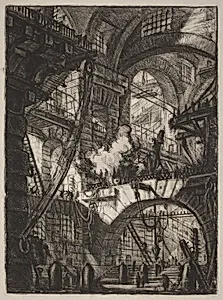
Medium
etching, engraving, sulphur tint or open bite, burnishing
Classification
Department
CG-E
Museum
National Gallery of Art, Washington, D.C.
Credit
Rosenwald Collection
Accession Number
1943.3.6991
Rights
Public Domain
Art Historical Context
Giovanni Battista Piranesi, the visionary 18th-century Italian, architect, and printmaker, captivates with *The Smoking Fire*, a etching and engraving published posthumously between 1800 and 1809. Renowned for his intricate vedute of ancient Rome and fantastical architectural fantasies like the *Carceri d'Invenzione* (inary Prisons), Piranesi infused his works with a sense of sublime grandeur and atmospheric depth. This print, housed in the National Gallery of Art's esteemed Rosenwald Collection, exemplifies ability to evoke mystery and scale through imagined, labyrinthine spaces. Piranesi's technical mastery shines in the medium: etching and engraving create precise lines, while sulphur tint or open bite techniques produce soft, smoky tonal gradients—perfectly suiting the title's fiery haze. Burnishing adds luminous highlights, enhancing the illusion of flickering light amid shadowy voids. These innovations allowed Piranesi to push printmaking beyond mere reproduction, rivaling painting in emotional intensity. As a highlight of the Prints department (CG-E), *The Smoking Fire* reflects Piranesi's enduring influence on Romanticism and neoclassicism, inspiring generations with its blend of ruinous beauty and imaginative power. Visitors are drawn into a world where architecture feels alive with tension and wonder.
About the Artist
Giovanni Battista Piranesi · 1720–1778
Giovanni Battista Piranesi (1720–1778) was an Italian printmaker, architect, and antiquarian whose visionary etchings of Rome and imaginary prisons revolutionized architectural representation and profoundly influenced both Neoclassicism and Romanticism. Piranesi stands as one of the most important printmakers of the eighteenth century, fundamentally shaping European perceptions of ancient Rome an...