
The South Sea Scheme
1721
Medium
etching and engraving
Dimensions
overall: 25.8 × 32.5 cm (10 3/16 × 12 13/16 in.)
Classification
Department
CG-E
Museum
National Gallery of Art, Washington, D.C.
Credit
Rosenwald Collection
Accession Number
1944.5.89
Rights
Public Domain
Art Historical Context
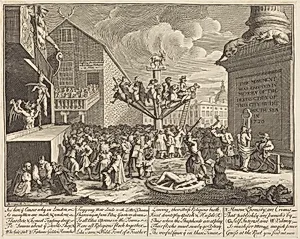
### The South Sea Scheme William Hogarth's *The South Sea Scheme* (1721) is a biting satirical print capturing the frenzy of London's financial scandal known as the South Sea Bubble. Created just a year after the South Sea Company's stock collapsed in 1720—wiping out fortunes and shaking the British economy—Hogarth a chaotic scene of speculators, from nobles to clerks, gambling away their wealth at a lottery office. This etching and engraving masterfully conveys the era's get-rich-quick mania, blending humor with sharp social critique. Hogarth, a pioneering English artist famous for his moralistic satires, used the print medium's precision to pack intricate details into a compact 25.8 × 32.5 cm sheet. Etching allowed fluid, expressive lines for exaggerated faces and gestures, while engraving added fine textures, making the work reproducible and widely accessible. As part of the National Gallery of Art's Rosenwald Collection, it exemplifies Hogarth's early mastery of sequential storytelling and his role in popularizing graphic satire. This piece remains a timeless warning on greed and speculation, resonating even today amid modern financial bubbles. Visitors will delight in spotting symbolic vignettes, like fallen investors amid rising stocks, in Hogarth's vivid tableau.
About the Artist
William Hogarth · 1697–1764
William Hogarth (1697-1764) was an English painter, printmaker, and pictorial satirist who became the first great English-born artist to attract admiration abroad. Born into poverty in London, the son of a failed schoolmaster who was imprisoned for debt, Hogarth's early experiences with the harsh realities of 18th-century urban life profoundly shaped his artistic vision. After apprenticing with si...