
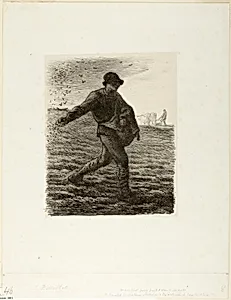
The Sower
Medium
Lithograph with scraping on stone on ivory China paper laid down on white wove paper
Dimensions
Image: 19.9 × 16.2 cm (7 7/8 × 6 7/16 in.); Primary support: 19.9 × 16.1 cm (7 7/8 × 6 3/8 in.); Secondary support: 35.8 × 27.7 cm (14 1/8 × 10 15/16 in.)
Classification
lithograph
Department
Prints and Drawings
Museum
Art Institute of Chicago
Accession Number
49846
Rights
Public Domain
Art Historical Context
Jean-François Millet's *The Sower* (1851) captures the quiet dignity of rural labor, a hallmark of the artist's Realist style. As a leading figure in the Barbizon School, Millet shifted focus from romanticized landscapes to the everyday struggles of peasants, reflecting mid-19th-century France social upheavals amid industrialization and rural poverty. This lithograph depicts a solitary figure casting seeds across a field at dusk, evoking biblical resonance and the cyclical toil of agrarian life. Printed on delicate ivory China paper laid down on white wove paper, the work showcases Millet's mastery of lithography—a revolutionary technique invented in the late 18th century that allowed for rich tonal variations through greasy crayon and ink on limestone. Here, Millet employed scraping on the stone to create subtle textures, mimicking the grit of soil and fading light, making this intimate 19.9 × 16.2 cm image remarkably expressive despite its small scale. Housed in the Art Institute of Chicago's Prints and Drawings Department, *The Sower* exemplifies how prints democratized art, enabling wider access to Millet's empathetic vision. Its enduring appeal lies in humanizing the laborer, influencing later movements like Social Realism.