
The Spanish Singer
1861–62
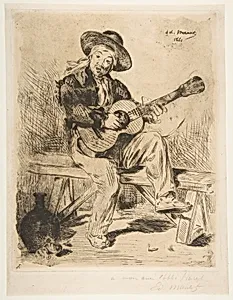
Medium
Etching and bitten tone; second state of seven
Dimensions
plate: 12 1/8 x 9 5/8 in. (30.8 x 24.4 cm) sheet: 13 7/16 x 10 5/16 in. (34.2 x 26.2 cm)
Classification
Prints
Department
Drawings and Prints
Museum
Metropolitan Museum of Art, New York, NY
Credit
The Elisha Whittelsey Collection, The Elisha Whittelsey Fund, 1952
Accession Number
52.608.2
Rights
Public Domain
Tags
Art Historical Context
Edouard Manet's *The Spanish Singer* (1861–62) captures the vibrant spirit of a male guitarist and singer, evoking the flair of Spanish performers popular in 19th-century Paris cafés. Created during Manet's early maturity, this etching reflects his fascination with Spanish culture, influenced by masters like Velázquez and G. The work ties into Manet's broader exploration of modern life and exoticism, bridging Realism and the emerging Impressionist movement he helped pioneer. Rendered in etching and bitten tone—the second state of seven—this print showcases Manet's innovative printmaking. Etching involves drawing through a waxy ground on a metal plate, allowing acid to "bite" lines for sharp detail, while bitten tone adds subtle, painterly shading through controlled acid exposure. These revisions across states reveal Manet's meticulous refinement, transforming a flat medium into a richly textured image of the singer's expressive pose and instrument. Housed in the Metropolitan Museum of Art's Drawings and Prints department, this 12⅛ × 9⅝-inch plate (from The Elisha Whittelsey Collection) highlights Manet's versatility beyond oils. It invites visitors to appreciate how prints democratized art, making his bold, controversial style accessible to a wider audience amid the cultural buzz of Second Empire France.
About the Artist
Edouard Manet · 1832–1883
Édouard Manet (1832-1883) was a French painter who played a pivotal role in the transition from Realism to Impressionism, often called the 'Father of Modern Art.' Born into a wealthy Parisian family, Manet defied his father's wishes for a legal career to pursue painting, studying under academic artist Thomas Couture. His revolutionary works 'Le Déjeuner sur l'herbe' and 'Olympia' (both 1863) scand...