
The Steel Bridge at Yokohama
7th–10th month, 1870
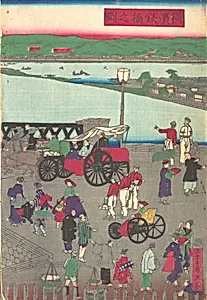
Medium
Hexaptych of woodblock prints; ink and color on paper
Dimensions
Image (a): 9 7/8 x 14 1/2 in. (25.1 x 36.8 cm) Image (b): 9 7/8 x 14 1/2 in. (25.1 x 36.8 cm) Image (c): 9 7/8 x 14 1/2 in. (25.1 x 36.8 cm) Image (d): 9 5/8 x 14 1/8 in. (24.4 x 35.9 cm) Image (e): 9 5/8 x 14 1/8 in. (24.4 x 35.9 cm) Image (f): 9 1/2 x 14 1/8 in. (24.1 x 35.9 cm)
Classification
Prints
Culture & Period
Japan · Meiji period (1868–1912)
Department
Asian Art
Museum
Metropolitan Museum of Art, New York, NY
Credit
Bequest of William S. Lieberman, 2005
Accession Number
2007.49.135a–f
Rights
Public Domain
Tags
Art Historical Context
**The Steel Bridge at Yokohama is a stunning hexaptych—a six-panel woodblock print—created by Utag (Gountei) Sadahide in 1870, during Japan's transformative Meiji period (1868–1912). with ink and color on paper, each panel measures around 9½–9⅞ x 14–14½ inches, combining to form a panoramic vista of Yokohama's iconic steel bridge. This Western-engineered structure buzzes with activity: men and women in traditional and modern attire, horse-drawn carriages, and lively crowds, capturing the port city's role as a gateway to global trade after Japan opened to the West in the 1850s. Sadahide, a master of the ukiyo-e tradition from the renowned Utagawa school, skillfully blends classical Japanese printmaking techniques—precise carving, vibrant colors, and fine gradations—with scenes of rapid modernization. Woodblock prints like this were affordable and popular, disseminating images of everyday life and novelty, much like newspapers today. The hexaptych format allowed for immersive, expansive storytelling, highlighting Yokohama's blend of old and new. This work, now in the Metropolitan Museum of Art's Asian Art collection (Bequest of William S. Lieberman, 2005), offers a vivid snapshot of Meiji Japan's embrace of progress, where steel bridges symbolized national ambition amid cultural flux. A delightful window into history! (198 words)
About the Artist
Utagawa (Gountei) Sadahide · 1807–1873
Utagawa Sadahide was born Hashimoto Kenjirō in 1807 in Fusa Province, in the area of modern Chiba Prefecture, Japan. In the 1820s he entered the studio of the enormously prolific and influential master Utagawa Kunisada, becoming one of Kunisada's most prominent pupils and adopting the studio name Sadahide along with the Utagawa school's celebrated lineage. By 1828 his name appeared on a monument l...