
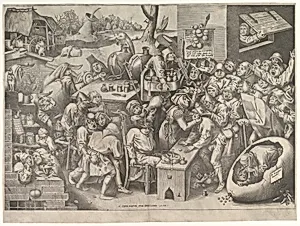
The Stone Operation or the Witch of Mallegem
Medium
Engraving; third state of five
Dimensions
sheet (cut to plate line): 13 15/16 x 18 3/4 in. (35.4 x 47.6 cm)
Classification
Prints
Department
Drawings and Prints
Museum
Metropolitan Museum of Art, New York, NY
Credit
Harris Brisbane Dick Fund, 1930
Accession Number
30.54.33
Rights
Public Domain
Tags
Art Historical Context
This engraving, created in 1559 after a design by Pieter Bruegel the Elder, captures the lively chaos of a Flemish village square. Bruegel, a leading figure of the Northern Renaissance, often explored themes of human folly through crowded, satirical scenes. Here, the title *The Stone Operation or the Witch of Mallegem* alludes to a popular medieval belief in extracting “stones of madness” from the heads of the foolish—a metaphor for curing ignorance or gullibility. The print was skillfully translated into engraving by Pieter van der Heyden and published by Hieronymus Cock, allowing Bruegel’s witty commentary to reach a wide audience beyond the original painting or drawing. The detailed line work of the engraving medium highlights the bustling activity: quacks, onlookers, and villagers crowd around makeshift operating tables while everyday objects take on symbolic meaning. Such prints were prized in the sixteenth century for their sharp social observation and technical precision, blending entertainment with moral instruction. Today, this impression in the Metropolitan Museum’s collection reminds visitors how Renaissance artists used humor and allegory to critique society, inviting us to reflect on timeless questions of wisdom and deception.
About the Artist
Pieter Bruegel the Elder|Pieter van der Heyden|Hieronymus Cock · 1525–1569
Pieter Bruegel the Elder, a pioneering Netherlandish painter of the Renaissance, was born around 1525–1530, likely in Breda in the Duchy of Brabant (present-day Netherlands). Little is known of his early family background, but he apprenticed under the Antwerp painter and designer Pieter Coecke van Aelst between approximately 1545 and 1550, mastering tapestry design, architecture, and painting tech...