
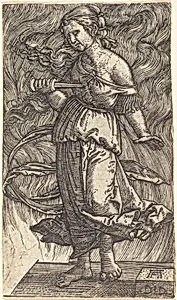
The Suicide of Dido
c. 1520/1530
Medium
engraving
Classification
Department
CG-E
Museum
National Gallery of Art, Washington, D.C.
Credit
Rosenwald Collection
Accession Number
1943.3.410
Rights
Public Domain
Art Historical Context
**The Suicide of Dido an engraving by Albrecht Altdorfer from around 1520–1530, captures a dramatic moment from Virgil's *Aeneid*. The queen of Carthage, abandoned by the Trojan hero Aeneas, plunges a sword into her chest amid swirling figures and a turbulent landscape. Altdorfer, a figure of the German Renaissance and the Danube School, masterfully blends classical mythology with his signature northern European style, emphasizing intricate details and atmospheric depth in a compact print format. As an engraving—a labor-intensive intaglio technique where lines are incised into a metal plate and inked— this work showcases Altdorfer's virtuosity in fine-line precision. Prints like this were revolutionary for disseminating complex narratives to a wider audience beyond paintings, making high art accessible during the early 16th century's growing print culture. The Rosenwald Collection at the National Gallery of Art preserves this gem, highlighting its role in bridging antiquity and Renaissance humanism. Altdorfer's evocative composition, with its dynamic poses and shadowy drama, reflects the era's fascination with fate, passion, and the antique world, inviting viewers to ponder Dido's tragic resolve. A poignant reminder of love's destructive power, it exemplifies how Northern artists infused classical tales with emotional intensity.
About the Artist
Albrecht Altdorfer · 1475–1538
Albrecht Altdorfer (c. 1480–1538) was a German painter, printmaker, and draftsman who stands as one of the founders of landscape painting as an independent genre. Born in Regensburg or nearby Altdorf, he learned art from his father Ulrich, a painter and miniaturist. Altdorfer spent most of his life in Regensburg, becoming a citizen in 1505 and later serving as the city's official architect and a m...