
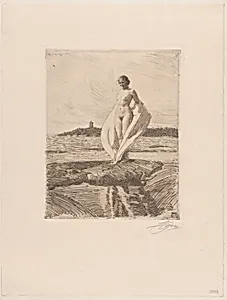
The Swan
1915
Medium
Etching; third state of three
Dimensions
Plate: 9 3/4 × 7 13/16 in. (24.8 × 19.8 cm) Sheet: 16 3/4 × 12 11/16 in. (42.6 × 32.3 cm)
Classification
Prints
Department
Drawings and Prints
Museum
Metropolitan Museum of Art, New York, NY
Credit
Harris Brisbane Dick Fund, 1917
Accession Number
17.3.679
Rights
Public Domain
Tags
Art Historical Context
Anders Zorn's *The Swan* (1915) is a masterful etching that exemplifies the Swedish artist's prowess in capturing the human form with luminous realism. Created during the final years of Zorn's career, this third-state impression— the most refined of three—features a female nude gracefully intertwined with a swan,oking classical themes of beauty nature. Acquired through the Harris Brisbane Dick Fund in1917, it resides in the Metropolitan Museum of's Department of Drawings and Prints, where its plate measures 9 3/4 × 7 13/16 inches. Zorn, a leading figure in late 19th- and early 20th-century European art, was renowned for his etchings, which number over 250 and rival his paintings in technical brilliance. Etching allowed him to manipulate light and texture with extraordinary precision: fine lines render the swan's feathers and the model's shimmering skin, while subtle aquatint tones suggest water's fluidity. This medium's significance lies in its intimacy—editions were limited, making each impression a collector's treasure—and Zorn's innovative use of states to evolve the image progressively. *The Swan* reflects Zorn's fascination with female nudes in natural settings, blending sensuality with poetic elegance amid the cultural shifts of World War I. A highlight for print enthusiasts, it invites visitors to marvel at how Zorn transformed copper plates into windows on ephemeral beauty.
About the Artist
Anders Zorn · 1860–1920
Anders Zorn (1860–1920), one of Sweden's most celebrated artists, was born on February 18 in Utmeland near Mora in Dalarna, and raised on his maternal grandparents' farm in the nearby hamlet of Yvraden. Displaying prodigious talent from a young age, he attended school in Mora Strand until age twelve, followed by secondary grammar school in Enköping, where he excelled in drawing people and horses. ...