
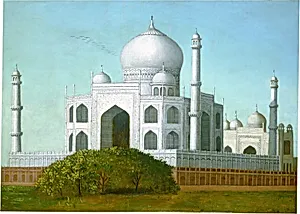
The Taj Mahal
c. 1860/1880
Medium
oil on canvas
Dimensions
overall: 88.7 x 116.7 cm (34 15/16 x 45 15/16 in.) framed: 90 x 118.1 x 3.2 cm (35 7/16 x 46 1/2 x 1 1/4 in.)
Classification
Painting
Department
CAB
Museum
National Gallery of Art, Washington, D.C.
Credit
Gift of Edgar William and Bernice Chrysler Garbisch
Accession Number
1978.80.3
Rights
Public Domain
Art Historical Context
Erastus Salisbury Field’s *The Taj Mahal* captures the iconic Indian mausoleum in luminous oil on canvas, measuring roughly 35 by 46 inches. Created between 1860 and 1880 by the-taught American folk artist, the painting reflects a growing 19th-century fascination with distant cultures, brought to U.S. audiences through prints and travelers’ accounts rather than direct observation. Field, best known for his crisp portraits, here turns his precise brushwork toward an architectural wonder completed two centuries earlier by Mughal emperor Shah Jahan. The work’s warm, educational tone invites viewers to appreciate both the monument’s timeless symmetry and Field’s imaginative interpretation. Rendered in oil, the medium’s rich layering allows subtle gradations of light across marble domes and minarets, translating an exotic landmark into an accessible American parlor picture. Generously gifted to the National Gallery of Art by Edgar William and Bernice Chrysler Garbisch, the canvas bridges continents and eras, reminding us how folk artists helped shape public curiosity about the wider world.
About the Artist
Erastus Salisbury Field · 1805–1900
1805–1900