
I'timad-ud-Daula's Tomb at Agra
c. 1820
Medium
Watercolor on paper watermarked J. Whatman with pencil, pen, ink and gold
Dimensions
51 × 74 cm (21 1/8 × 29 1/8 in.)
Classification
painting
Department
Arts of Asia
Museum
Art Institute of Chicago
Accession Number
210482
Rights
Public Domain
About this artwork
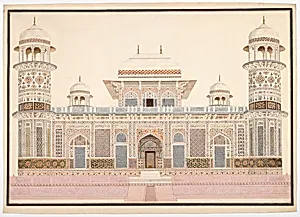
This architectural rendering of a magnificent tomb at Agra provides an accurate depiction of the semiprecious stones inlaid in white marble, a technique known as pietra dura, and the carved white marble jali screens of the mausoleum built by the Mughal empress Nur Jahan (1577–1645). She commissioned this building in honor of her father, Mirza Ghiyas Beg, who rose to become the prime minister under the emperor Jahangir (reigned 1605–27) and held the exalted title I’timad-ud-Daula (Pillar of the E...
Art Historical Context
This delicate watercolor captures the serene elegance of I'timad-ud-Daula's Tomb in Agra, a jewel-like Mughal mausoleum built in the early seventeenth century. Created around 1820, the painting reflects the continued admiration for Mughal architecture during a period of shifting political landscapes in India. Its careful attention to the tomb's geometric marble inlay and riverside setting invites viewers to appreciate both the monument's timeless beauty and its role as an architectural precursor to the Taj Mahal. The artist employed a refined combination of watercolor, pencil, pen and ink, accented with gold on J. Whatman paper, a high-quality British stock often favored in colonial-era works. These layered techniques allow for luminous detail in the structure's white marble surfaces and lush garden surroundings, blending precise draftsmanship with subtle color washes. The inclusion of gold highlights evokes the opulence of the original monument while demonstrating the artist's skill in merging local subject matter with European materials and methods. Housed in the Art Institute of Chicago's Arts of Asia collection, this sizable sheet (roughly 51 by 74 centimeters) serves as a cultural bridge between Mughal heritage and nineteenth-century artistic exchange. It offers modern visitors an intimate glimpse into how India's architectural wonders were documented and celebrated across cultures.
About the Artist
Unknown
The artist designated as "Unknown" in our virtual museum's collection exemplifies a poignant chapter in art history: creators whose identities have faded into obscurity despite the enduring power of their work. With only one known artwork attributed to them in our holdings, this figure represents countless anonymous hands that shaped visual culture across centuries. Museums worldwide, including th...