
The Talmud Teacher
1922
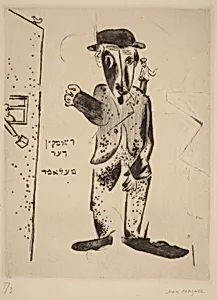
Medium
drypoint in black on laid paper (artist's proof)
Dimensions
plate: 24.5 x 18.9 cm (9 5/8 x 7 7/16 in.) sheet: 35.6 x 27 cm (14 x 10 5/8 in.)
Classification
Department
CG-W
Museum
National Gallery of Art, Washington, D.C.
Credit
Gift of Mr. and Mrs. Gerhard E. Pinkus
Accession Number
2000.45.7
Rights
Public Domain
Art Historical Context
Marc Chagall’s *The Talmud Teacher* (1922) captures a quiet moment of Jewish religious study with the artist’s characteristic blend of memory, symbolism, and gentle fantasy. Created as a drypoint—an intaglio technique in which the scratches directly into a metal plate—the work displays the soft, velvety burr that gives each line a rich, tactile quality. Printed in black on laid paper as an artist’s proof, the image reflects Chagall’s deep connection to his Eastern European Jewish roots during a period when he was reestablishing himself in Paris after the First World War. Though modest in scale, the print carries significant cultural weight. Chagall frequently returned to scenes of Talmudic learning, portraying them not as rigid scholarship but as luminous, almost dreamlike experiences that link generations of tradition. The restrained black-and-white medium heightens the intimacy of the subject, inviting viewers to focus on the expressive gestures and the spiritual atmosphere rather than color. As a gift to the National Gallery of Art, this artist’s proof offers a rare glimpse into Chagall’s printmaking process and his lifelong effort to preserve Jewish cultural memory through modernist art.
About the Artist
Marc Chagall · 1887–1985
Marc Chagall, born Moishe Shagal on July 7, 1887, in Liozna near Vitebsk in the Russian Empire (now Belarus), grew up as the eldest of nine children in a devout Jewish family confined to the Pale of Settlement. His father worked as a herring merchant's porter, while his mother sold groceries from home, instilling in young Chagall a deep connection to Hasidic Judaism and Eastern European folklore a...