
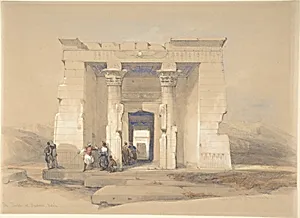
The Temple at Dendur, Nubia
1848
Medium
Watercolor and gouache (bodycolor) over graphite on beige wove paper
Dimensions
sheet: 7 11/16 x 10 1/2 in. (19.5 x 26.7 cm)
Classification
Drawings
Department
Drawings and Prints
Museum
Metropolitan Museum of Art, New York, NY
Credit
Gift of Philippe and Edith de Montebello, 2007
Accession Number
2007.539
Rights
Public Domain
Tags
Art Historical Context
Step into the sun-drenched sands of ancient Nubia with David Roberts' exquisite 1848 watercolor, *The Temple at Dendur, Nubia*. This intimate drawing on beige wove paper (7 11/16 x 10 1/2 in.) captures the majestic ruins of the temple, its towering columns rising amid weathered stones, with figures of men evoking the site's timeless allure. Now housed in the Metropolitan Museum of Art's Drawings and Prints department—thanks to the generous gift of Philippe and Edith de Montebello in 2007—this piece transports visitors to Egypt's remote southern frontier. Roberts, a pioneering 19th-century Scottish artist and traveler, was renowned for his meticulous Orientalist depictions of the Middle East and North Africa, drawn from his 1838–1840 expedition. His works, blending topographic precision with romantic evocation, introduced Western audiences to Egypt's architectural wonders during a era of fervent Egyptomania sparked by Napoleon's campaigns and early archaeology. Crafted in watercolor and gouache (bodycolor) over graphite underdrawing, the medium lends luminous depth and opacity to the sunlit stone and shadowed recesses, highlighting Roberts' virtuoso technique in rendering texture and light on a modest scale. A testament to 19th-century exploration and artistic documentation, this drawing celebrates the enduring cultural legacy of Nubian temples.
About the Artist
David Roberts · 1796–1864
Scottish painter and lithographer.