
The Temptation of St. Anthony
1509
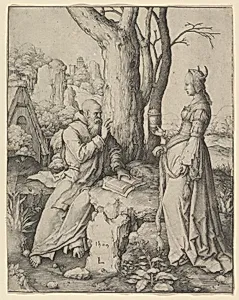
Medium
Engraving
Classification
Prints
Department
Drawings and Prints
Museum
Metropolitan Museum of Art, New York, NY
Credit
Gift of Felix M. Warburg and his family, 1941
Accession Number
41.1.22
Rights
Public Domain
Tags
Art Historical Context
In the early 16th century, Dutch artist Lucas van Leyden created *The Temptation of St Anthony* (1509), a masterful that captures a pivotal moment in Christian hagiography. At just 22 years old, van Ley—already a prodigy who began engraving as a child—depicts the desert hermit saint besieged by demonic temptations, surrounded by alluring women, grotesque figures, twisted trees, and scattered books symbolizing worldly knowledge. This Northern Renaissance print draws from medieval legends, where St. Anthony endures visions of vice to affirm his faith, a theme popularized in art to inspire devotion amid Reformation-era spiritual tensions. Van Leyden's engraving technique shines here, with fine lines etching intricate details into copper plates for precise, reproducible images. Unlike paintings, prints like this allowed widespread dissemination to pilgrims and collectors, democratizing religious iconography. His style blends Hieronymus Bosch's fantastical grotesques with crisp, atmospheric landscapes, showcasing innovative cross-hatching for depth and texture in a compact 7x5-inch format. Housed in the Metropolitan Museum of Art's Drawings and Prints department (gift of Felix M. Warburg and family, 1941), this work exemplifies van Leyden's pivotal role in elevating printmaking to fine art, bridging Gothic traditions and emerging realism for audiences grappling with faith and temptation.
About the Artist
Lucas van Leyden · 1484–1533
Lucas van Leyden (1494–1533) was a Dutch painter and printmaker who stands among the greatest engravers of the Northern Renaissance. Born in Leiden as either Lucas Hugensz or Lucas Jacobsz, he lived and worked primarily in his native city, achieving international renown that rivaled the German master Albrecht Dürer. Lucas van Leyden revolutionized Netherlandish printmaking and was among the first...