
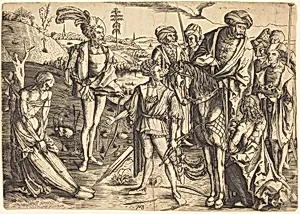
The Testing of the King's Sons
c. 1500
Medium
engraving on laid paper
Dimensions
sheet (trimmed to plate mark): 17.1 x 24.3 cm (6 3/4 x 9 9/16 in.)
Classification
Department
CG-E
Museum
National Gallery of Art, Washington, D.C.
Credit
Ailsa Mellon Bruce Fund
Accession Number
1985.50.1
Rights
Public Domain
Art Historical Context
*The Testing of the King's Sons an engraving by the enigmatic Master MZ around 1500, captures a dramatic narrative scene in intricate detail on laid paper. Measuring just 17.1 x 24.3 cm, this small-scale print exemplifies the Northern Renaissance's mastery of printmaking, where artists like the anonymous Master MZ—likely a German or Netherlandish engraver identified only by his monogram— works that could be widely collected and shared. The title hints at a biblical or legendary tale, possibly testing royal heirs through trials of virtue or strength, rendered with fine lines that convey texture, emotion, and depth. Engraving, the medium here, was revolutionary in the late 15th and early 16th centuries, allowing precise control over tonal gradations via burin incisions on a copper plate. Printed on laid paper—distinguished by its visible chain lines—this technique democratized art, making high-quality images affordable beyond paintings. Master MZ's style, with its meticulous cross-hatching and narrative focus, bridged Gothic traditions and emerging Renaissance realism, influencing later printmakers like Albrecht Dürer. Housed in the National Gallery of Art's collection through the Ailsa Mellon Bruce Fund, this rare work invites visitors to ponder the era's fascination with moral tales and princely legacies. Up close, its technical virtuosity reveals a world in miniature, perfect for savoring the artistry of an overlooked master.
About the Artist
Master MZ · 1477–1525
The artist known as Master MZ is one of the most accomplished and enigmatic printmakers of the German Renaissance, active around the turn of the sixteenth century. The designation derives from the monogram MZ with which the artist signed a small but technically extraordinary group of engravings, and despite sustained scholarly inquiry, the individual behind these initials has never been conclusive...