
The Three Companions
December 1912
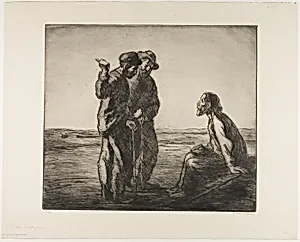
Medium
Etching and drypoint on ivory laid paper
Dimensions
Image/plate: 34.6 × 39.6 cm (13 5/8 × 15 5/8 in.); Sheet: 44.2 × 54.8 cm (17 7/16 × 21 5/8 in.)
Classification
etching
Department
Prints and Drawings
Museum
Art Institute of Chicago
Accession Number
49707
Rights
Public Domain
Art Historical Context
Théophile-Alexandrelen's *The Three Companions*December 1912) captures the artist's affection for feline subjects in a masterful etching and drypoint on ivory laid paper. Measuring 34.6 × 39.6 cm, this intimate print from the Art Institute of Chicago's Prints Drawings collection exemplifies Steinlen's prowess in the medium. A Swiss-born artist who thrived in fin-de-siècle Paris, Steinlen was a key figure in Art Nouveau and poster art, renowned for vivid depictions of Montmartre's working-class, cabaret scenes, and beloved cats—often symbols of quiet companionship amid urban hustle. Etching involves incising a metal plate with acid for precise lines, while drypoint adds a direct, scratched texture that produces a soft, velvety "burr" for depth and warmth. Steinlen's blend of these techniques brings a tactile richness to the three cats, likely huddled together, evoking tenderness and everyday poetry. Created just before World War I, the work reflects a nostalgic pause in an era of rapid modernization, when prints like this made fine art accessible beyond elite salons. Housed at the Art Institute of Chicago, *The Three Companions* highlights Steinlen's enduring legacy as a storyteller of the humble and heartfelt, inviting visitors to appreciate the subtle artistry of printmaking and its role in democratizing beauty.
About the Artist
Théophile-Alexandre Pierre Steinlen · 1859–1923
Théophile Alexandre Steinlen, born on November 10, 1859, in Lausanne, Switzerland, grew up in an environment steeped in artistic influence, with his grandfather serving as a drawing teacher in nearby Vevey. He studied literature at the University of Lausanne before working as a designer trainee in a Mulhouse textile mill. In his early twenties, around 1881, Steinlen married Émilie Mey, and the cou...