
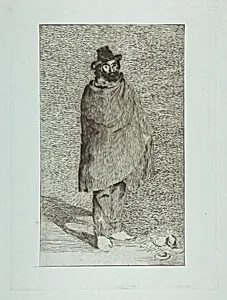
The Philosopher (Le Philosophe)
1865–66
Medium
Etching and drypoint on blue laid paper
Dimensions
plate: 12 1/2 x 9 1/4in. (31.8 x 23.5cm) sheet: 17 5/8 x 11 1/2in. (44.8 x 29.2cm)
Classification
Prints
Department
Drawings and Prints
Museum
Metropolitan Museum of Art, New York, NY
Credit
Rogers Fund, 1921
Accession Number
21.76.18
Rights
Public Domain
Tags
Art Historical Context
Edouard Manet's *The Philosopher (Leophe)*, created around 1865–66, captures the introspective essence of a contemplative male figure, evoking the timeless archetype of the thinker. During this period, Manet at the forefront of French modernism, challenging academic conventions with his bold Realism and proto-Impressionist style. This print his fascination with intellectual subjects, blending portraiture with philosophical symbolism amid the cultural ferment of Second Empire Paris, where ideas of progress and doubt swirled. Executed in etching and drypoint on blue laid paper, the work showcases Manet's mastery of printmaking techniques. Etching involves biting lines into a metal plate with acid for precise, fluid contours, while drypoint adds velvety burrs from direct engraving, lending rich texture and depth. At 12½ × 9¼ inches, its intimate scale invites close viewing, highlighting Manet's innovative use of these methods to rival painting's expressiveness—a rarity for a painter primarily known for canvases. Housed in the Metropolitan Museum of Art's Drawings and Prints department (Rogers Fund, 1921), this piece underscores Manet's versatility and enduring influence on modern art. For visitors, it offers a meditative pause, pondering the philosopher's gaze as a mirror to our own curiosities.
About the Artist
Edouard Manet · 1832–1883
Édouard Manet (1832-1883) was a French painter who played a pivotal role in the transition from Realism to Impressionism, often called the 'Father of Modern Art.' Born into a wealthy Parisian family, Manet defied his father's wishes for a legal career to pursue painting, studying under academic artist Thomas Couture. His revolutionary works 'Le Déjeuner sur l'herbe' and 'Olympia' (both 1863) scand...