
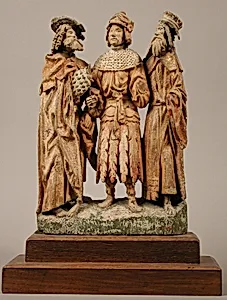
The Three Magi (?)
Unknown Artist
15th century
Medium
Wood with paint and gilding
Dimensions
Overall (without base): 12 1/8 x 8 1/4 x 2 in. (30.8 x 21 x 5.1 cm) Overall (with base): 14 3/4 x 10 7/8 x 3 11/16 in. (37.4 x 27.6 x 9.3 cm)
Classification
Sculpture-Wood
Culture
French or South Netherlandish
Department
Medieval Art
Museum
Metropolitan Museum of Art, New York, NY
Credit
Gift of J. Pierpont Morgan, 1917
Accession Number
17.190.377
Rights
Public Domain
Art Historical Context
This exquisite 15th-century wooden sculpture, tentatively titled *The Three Magi*, hails from French or South Netherlandish during the late Gothic period. Carved from wood and adorned with vibrant paint and gilding, it the revered biblical figures who brought gifts to the infant Christ, a motif central to medieval Christian devotion. The modest scale—about 12 inches tall without its base—suggests it may have graced a private altar, processional cross, or nativity scene, inviting intimate contemplation amid the era's growing emphasis on emotional piety. The use of polychrome and gilding was a hallmark technique, transforming humble wood into a shimmering vision of heavenly splendor. Gold leaf evoked divine light, while delicate painting highlighted facial expressions and flowing robes, blending realism with symbolic grandeur. Attributed to an unknown artist, such works reflect the collaborative craft of regional workshops, where sculptors and painters collaborated to inspire faith. A generous gift from J. Pierpont Morgan in 1917, this piece now resides in The Metropolitan Museum of Art's Medieval Art collection, offering a window into the spiritual artistry of late medieval Europe. Its survival speaks to the enduring allure of these small-scale treasures.